All outfit images are AI-generated. The cut, patterns and colours of historical and ethnic dress may be inaccurate. They are for creative reference only and are not a basis for serious historical or folklore research.
Bingata Robe & Vermilion Nakagi
红型长衣+朱红中着
Description
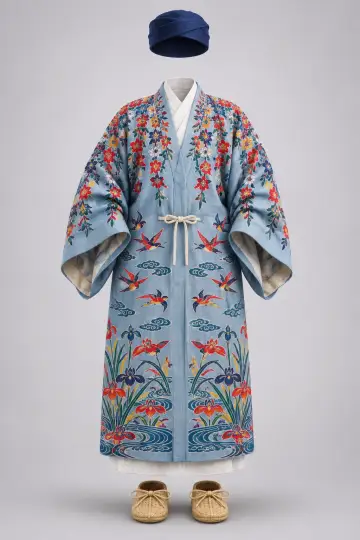
银色单支素面金属发簪横插在头顶发髻上,簪身两端露在发髻外;内层为两件式丝绸中着的上件,朱红底饰有细碎的红型花叶纹,交领分里外两层,领口与前襟在表着领下露出窄条,筒袖比表着袖窄;外层为米白底丝绸红型染表着,型纸防染的满身纹样以朱红、藏青、草绿、紫和浅黄色描绘花枝、凤鸟、折扇与流云,衣身宽阔,衣长及脚踝且不折御端折,宽大筒袖的袖口垂至腰下,朱红色素面宽领未缝固,沿交叠的前襟自然折成长垂下;下装为两件式中着的丝绸筒形长裙,朱红底饰有与上件相同的细碎红型花叶纹,长及脚踝,大部分被表着遮住,下摆略露;紫色丝绸细带绕腰一圈,在身前打平结,两条带端垂至大腿;平底草履配米白色素面鞋底和朱红色鼻绪。
Prompt
A single plain silver-colored metal hairpin is inserted horizontally through the bun on top of the head, with both ends extending beyond it; the inner upper garment is one half of a two-piece silk nakagi, with a vermilion ground covered in small bingata flowers and leaves, a crossed collar in inner and outer layers, narrow strips of the neckline and front edges visible beneath the outer collar, and tubular sleeves narrower than those of the outer robe; the outer garment is a loose, ankle-length silk bingata-dyed robe with no ohashori fold, its cream ground covered in stencil-resist motifs of flowering branches, phoenixes, folding fans, and flowing clouds in vermilion, deep navy, grass green, purple, and pale yellow, with wide tubular sleeves whose openings hang below the waist and an unsecured plain vermilion wide collar that folds naturally down the overlapping front; the lower half of the nakagi is an ankle-length tubular silk skirt in the same vermilion fabric with small bingata flowers and leaves, mostly covered by the outer robe with a little of the hem showing; a narrow purple silk cord wraps once around the waist and is tied in a flat knot at the front, with both ends hanging to the thighs; flat zori have plain cream soles and vermilion thongs.
About this outfit
Ryusō was worn in the Ryukyu Kingdom and remains a traditional regional dress in Okinawa Prefecture and the Amami Islands.1 It has a loose body and wide, tubular sleeves; the garment is cut to the wearer's height and worn without an ohashori fold.(partly sourced)1 The collar is not sewn down, and some styles have a wide collar folded over a long distance. When a sash is used, it is tied at the front; the garment can also be worn without one by tucking its front panels into the undergarment's sash.(partly sourced)1 Formal Ryukyuan dress consists of an outer robe worn over a two-piece undergarment, with different combinations of materials and colors creating different effects.1 Bingata is a traditional Okinawan stencil-resist dyeing technique that often depicts flowers, birds, and clouds in multiple colors; during the Ryukyu Kingdom period, clothing patterns and colors were also governed by rules of social status.(partly sourced)2
- 日文Wikipedia《琉装》, 日文Wikipedia, 概要
- Wikipedia《Bingata》, Wikipedia, 正文
Compiled by AI. Sources were cross-checked independently, but AI can still make mistakes; do not use this as a direct basis for serious research.
Example images are for viewing only, not for download.
Outfit details
- Category
- Ethnic & traditional
- Occasion
- Festival
- Region and culture
- Japan
- Era
- Contemporary
- Gender
- Female