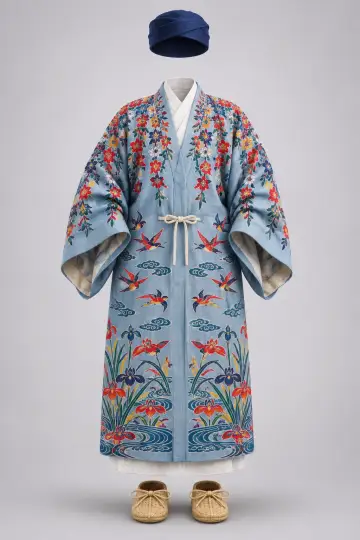
All outfit images are AI-generated. The cut, patterns and colours of historical and ethnic dress may be inaccurate. They are for creative reference only and are not a basis for serious historical or folklore research.
Appliqué-Trim Robe & Bead Necklace
镶边长衣+玻璃珠项链
Description
深藏青刺绣头带,白线绣对称方角折线纹;深蓝、浅蓝绿与白色相间的玻璃珠项链,垂到胸前;米白素色木棉衬衣;米白色树皮纤维布筒袖长衣,前襟交叠右前,长及脚踝上方,领、前襟、袖口与下摆缝深藏青木棉布宽边,下摆贴布高起成大块,以白线与少量红线绣出涡卷、尖角与直线组成的对称阿伊努传统纹样,转角处为方角;本色浅褐细带,在腰前打小结;深藏青前垂,下缘白线绣方角折线纹;深藏青刺绣手甲;暗银色金属球耳环;浅褐色鹿皮软底短靴。
Prompt
Deep navy embroidered headband with symmetrical angular fret motifs in white thread; glass bead necklace in deep blue, pale teal and white, hanging to the chest; plain off-white cotton under-robe; off-white bark-fiber robe with straight tube sleeves, front panels overlapping right over left, reaching just above the ankles, with broad deep navy cotton borders at the collar, front edges, cuffs and hem, the hem appliqué rising in large blocks, embroidered in white with touches of red in symmetrical traditional Ainu motifs of scrolls, thorn-like points and straight lines with squared corners; narrow natural tan sash tied in a small knot at the front; deep navy front apron with an angular fret border in white; deep navy embroidered hand covers; dark silver hoop earrings with a small metal ball; soft-soled tan deerskin ankle boots.
About this outfit
Ainu women and men wear wrap-front robes with tubular sleeves; women's robes generally fall between the shin and ankle and are secured with a narrow belt.1 These robes have no overlapping front panels called okumi, so the hem can fall open; women traditionally wear an undergarment called mour and a front apron called mantari.1 Ainu attus is woven from fibers of the inner bark of trees such as elm and is often made into clothing. Both men and women wear long, straight-sleeved robes with overlapping fronts; men's robes extend from below the knee to the shin, while women's extend from the shin to the ankle.1 Women's accessories include an embroidered headband called matanpushi and metal earrings with pendants called ninkari; they may also wear a glass-bead necklace called tamasay that reaches the chest.2 Traditional Ainu textiles also include attus, woven from inner bark fibers; together with embroidered and appliquéd formal clothing, it reflects different approaches to materials and decoration.(partly sourced)1
- 日文Wikipedia《アットゥシ》, 日文Wikipedia, アイヌ民族服の形状
- Wikipedia《Ainu people》, Wikipedia, Clothing
Compiled by AI. Sources were cross-checked independently, but AI can still make mistakes; do not use this as a direct basis for serious research.
Example images are for viewing only, not for download.
Outfit details
- Category
- Ethnic & traditional
- Occasion
- Festival
- Region and culture
- Japan
- Era
- Contemporary
- Gender
- Female