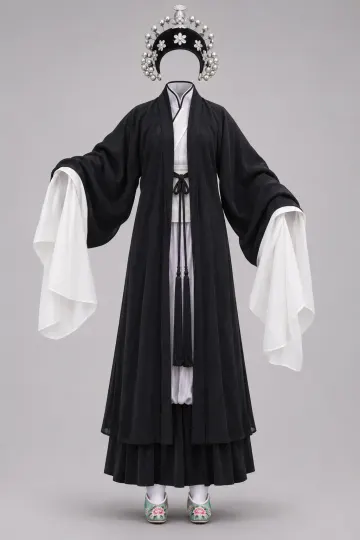
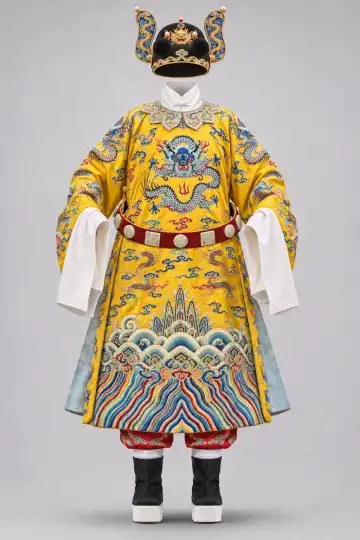
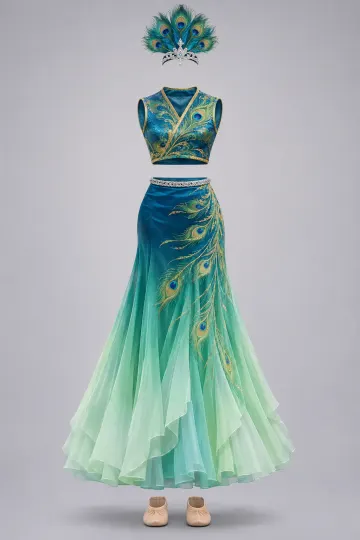
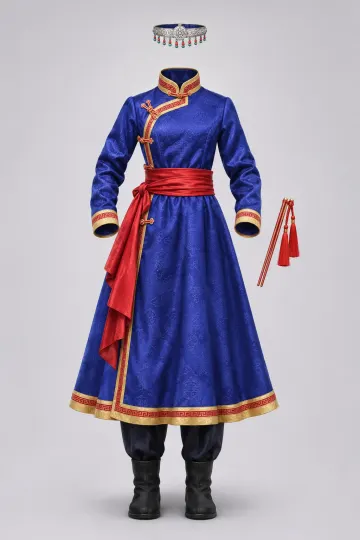
All outfit images are AI-generated. The cut, patterns and colours of historical and ethnic dress may be inaccurate. They are for creative reference only and are not a basis for serious historical or folklore research.
Royal-Blue Kao, Back Flags & Thick Boots
宝蓝大靠+靠旗+厚底靴
Description
头戴硬胎扎巾盔;颈配三尖靠领;内穿素色素箭,又称衬箭;内配水衣、胖袄及护领;白布小袖套于窄袖口,长半尺、宽三寸;外穿宝蓝色大缎男硬靠,圆领紧袖,前后分片、左右开衩,长及足,靠袖连接蝶翅形护肩,胸腹处的靠肚硬挺凸起,下连前大马面,后接后裳甲,靠肚外镶红缎宽边,通身以平金绣为主,辅以穿珠绣和绒绣,鱼鳞锦铺地,周身饰浪花纹,靠肚及靠袖绣二龙戏珠和海水江崖,前大马面绣麒麟口吐玉书并缀虎头吊鱼,后裳甲绣降龙戏珠;下穿红色彩裤;腰束两片靠腿子,由腰垂至足,遮护双腿;足穿素色布袜;外穿黑色缎面白底厚底靴;背后硬皮背壶内插四面三角形靠旗,旗上附飘带;胸前围绕绸制靠绸。
Prompt
A rigid framed head wrap is worn on the head; a three-point standing collar encircles the neck; a plain-colored inner arrow robe, also called a lining arrow robe, is worn underneath; the inner layers include a water jacket, padded jacket, and collar guard; white cloth sleeve extensions, half a chi long and three cun wide, cover the narrow cuffs; a men's rigid armor robe of royal-blue heavy satin reaches the feet, with a round neckline, tight sleeves, separate front and back panels, and side slits; its sleeves join butterfly-wing-shaped shoulder guards, and its stiff, raised chest-and-abdomen panel connects to a large front apron and a rear armor skirt; the chest panel is edged with a wide band of red satin, and the robe is worked mainly in couched gold-thread embroidery with beadwork and chenille embroidery, featuring a fish-scale brocade ground and wave borders throughout; the chest panel and sleeves bear two dragons playing with a pearl above waves and cliffs, the front apron bears a qilin holding a jade book in its mouth and a tiger-head pendant with a hanging fish, and the rear armor skirt bears a descending dragon playing with a pearl; red trousers are worn underneath; two leg guards are tied at the waist and hang to the feet, covering the legs; plain-colored cloth socks are worn with thick-soled boots with black satin uppers and white soles; four triangular armor flags with streamers are inserted into a rigid leather flag holder on the back; a silk sash is wrapped around the chest.
About this outfit
Kao, also known as armor costume, is worn by military roles in Peking opera. Its form derives from historical armor and has been artistically heightened and embellished.1,2 A male hard kao has separate front and back panels, side slits, and a hem reaching the feet. Butterfly-shaped guards cover the shoulders, a three-pointed collar encircles the neck, and two leg panels hang from the waist to the feet.1 A male hard kao in royal-blue satin is embroidered primarily in couched gold thread with a fish-scale ground and round longevity motifs. Its belly panel and sleeves bear two dragons playing with a pearl and sea-and-cliff designs; the front apron depicts a qilin bearing a jade book in its mouth, while the rear skirt panel shows a descending dragon playing with a pearl.1 A hard kao has a holder secured at the back for four triangular flags with streamers; a kao without these flags is called a soft kao.(partly sourced)1,3,2 A kao may be worn with a hard-structured zhajin helmet, red stage trousers, and thick-soled boots; white cloth cuffs are fitted over the narrow sleeves for a neat finish.(partly sourced)4,1
- 深圳龙岗区文化广电旅游体育局主办线上展览《龙凤呈祥——中国京剧服饰纹样图片展》(2021年6–8月), 深圳龙岗区文化广电旅游体育局主办线上展览, 2021, 正文
- 数艺网:戏服科普丨传统戏曲的服装分类之男靠, 正文
- 美轮美奂的戏曲行头何以浸润中国特有的审美文化, 正文
- 中国国家京剧院官网《漫谈京剧传统服饰》, 中国国家京剧院官网, 小袖的应用
Compiled by AI. Sources were cross-checked independently, but AI can still make mistakes; do not use this as a direct basis for serious research.
Example images are for viewing only, not for download.
Outfit details
- Category
- Stage & theatrical
- Occasion
- Performance
- Region and culture
- China › Han
- Era
- Contemporary
- Social role
- Performer
- Gender
- Male
- Season
- All-season