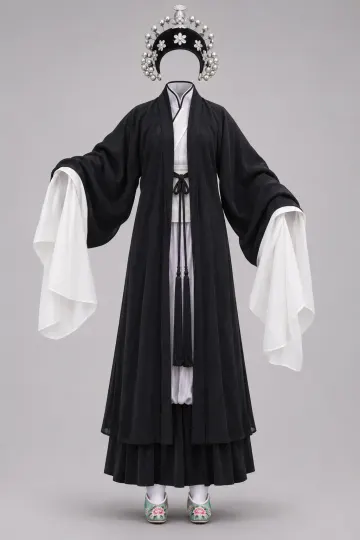
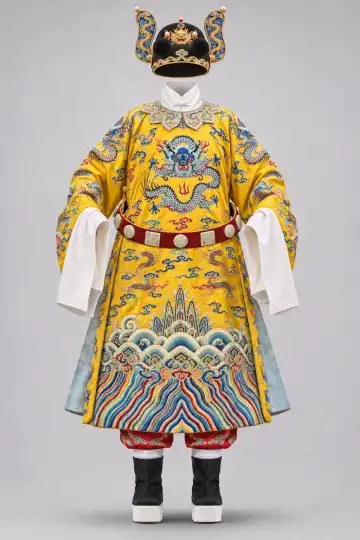
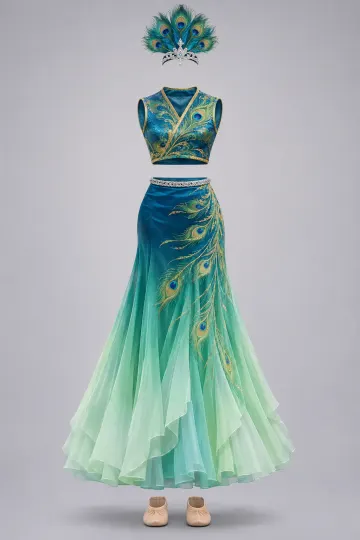
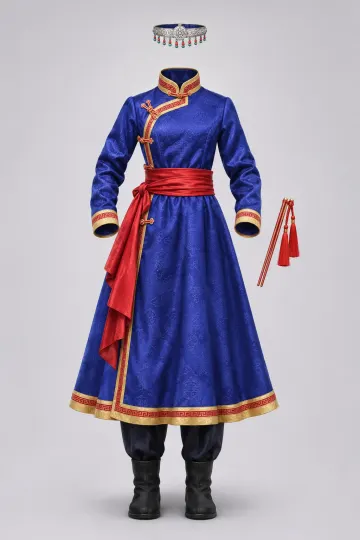
All outfit images are AI-generated. The cut, patterns and colours of historical and ethnic dress may be inaccurate. They are for creative reference only and are not a basis for serious historical or folklore research.
White Floral Robe & Thick-Sole Boots
白花褶子+厚底靴
Description
白色软缎小生巾分前后片,前片折叠、后片平直,底缘掐绦线,绣有缠枝牡丹,两侧各垂一条末端作如意头的耳子,帽后垂两根绣花飘带;内穿水衣,白布护领从褶子领口露出;白色男花褶子以柔软绉缎制成,长款宽松,衣长及足,斜襟大领交领,大襟向右开,腰系丝绦,阔袖袖口缀白色纺绸水袖,水袖长约一尺余,通身均衡分布彩绣牡丹团花;白色彩裤穿在褶子内,长及脚踝,露出裤脚;腰间系丝绦;足穿白色素袜;脚穿黑缎面白底厚底靴。
Prompt
A white soft-satin xiaosheng headdress has separate front and back panels, with a folded front, a straight back, corded trim along the lower edge, and embroidered scrolling peonies; an ear flap with a ruyi-shaped tip hangs on each side, and two embroidered streamers hang from the back; an undergarment is worn beneath the robe, with a white cloth collar protector visible at the neckline; the long, loose white men's huazhezi robe is made of soft crepe satin and reaches the feet, with a broad overlapping collar, a right-fastening front, a silk waist cord, wide sleeves, and white silk water sleeves extending a little over one chi, while colorful embroidered peony roundels are evenly distributed across the robe; white trousers are worn beneath the robe, reaching the ankles with the cuffs visible; a silk cord is tied at the waist; plain white socks are worn with thick-soled boots that have black satin uppers and white soles.
About this outfit
Zhezi robes and chayi jackets are both forms of everyday dress on the opera stage. Beijing opera costumes transform and exaggerate elements of everyday clothing into a stylized system suited to performance.1,2 The xiaosheng jin, also called a wensheng jin or gongzi jin, is worn for roles such as young gentlemen and scholars. It has separate front and back panels, with the front folded, the back flat, and braid edging the lower rim.(No checkable source found; for reference only) The xiaosheng jin has hanging side flaps with ruyi-shaped ends and two embroidered streamers at the back. It can be adapted from the same basic headpiece as the wusheng jin, which omits the streamers and adds other ornaments.(No checkable source found; for reference only) Most Beijing opera costumes, apart from close-sleeved styles, have white silk water sleeves attached at the cuffs to extend gestures and aid performance. Caiku are roomy under-trousers worn beneath the costume, in plain or patterned forms.2 A huazhezi worn for wuchou roles can be made of crepe satin with colored embroidery. It may be worn open or draped diagonally over a matching kuayi and kuaku ensemble, with thin-soled boots.4
- 美轮美奂的戏曲行头何以浸润中国特有的审美文化, 正文
- 中国国家京剧院官网《漫谈京剧传统服饰》, 中国国家京剧院官网, 正文
- 中国非遗网「非遗知识课堂」《戏曲舞台上的盔头》(作者杨耐)(一), 中国非遗网, 正文
- 深圳龙岗区文化广电旅游体育局主办线上展览《龙凤呈祥——中国京剧服饰纹样图片展》(2021年6–8月), 深圳龙岗区文化广电旅游体育局主办线上展览, 2021, 黑缎彩绣散摆蝴蝶纹男花褶子
Compiled by AI. Sources were cross-checked independently, but AI can still make mistakes; do not use this as a direct basis for serious research.
Example images are for viewing only, not for download.
Outfit details
- Category
- Stage & theatrical
- Occasion
- Performance
- Region and culture
- China › Han
- Era
- Contemporary
- Social role
- Performer
- Gender
- Male
- Season
- All-season