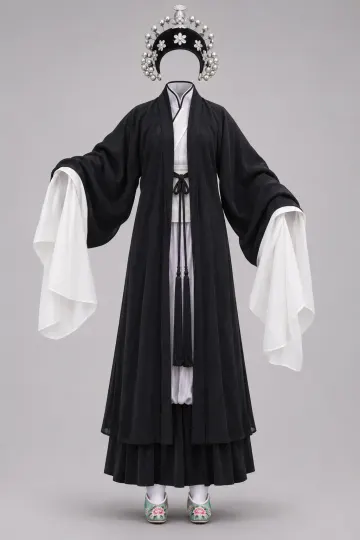
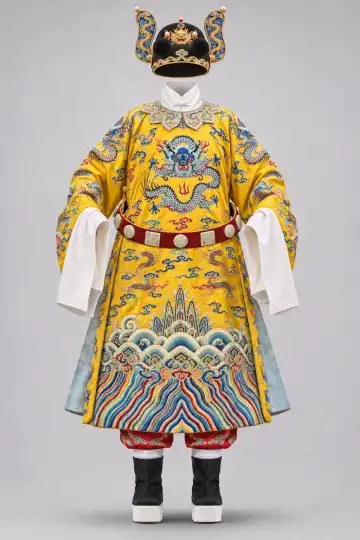
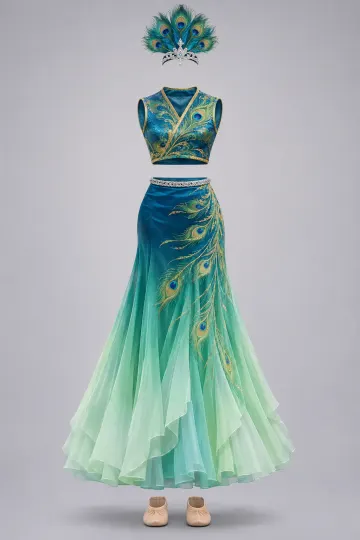
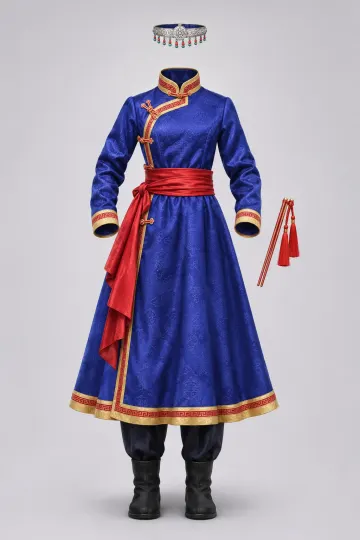
All outfit images are AI-generated. The cut, patterns and colours of historical and ethnic dress may be inaccurate. They are for creative reference only and are not a basis for serious historical or folklore research.
Royal-Blue Armor & Helmet
宝蓝大靠+盔头
Description
头戴硬胎扎巾盔;内穿素色水衣、胖袄和素箭,配白布护领,素箭窄袖的袖口套白布小袖;外穿宝蓝色大缎男硬靠,靠身长及足,前后两片、左右开衩,圆领外围饰三尖靠领,紧袖连蝶翅形护肩,胸腹靠肚硬挺凸起,下连前大马面,后有裳甲;硬靠以平金绣为主,辅以穿珠绣和绒绣,鱼鳞锦铺地,间饰团寿字,周身以浪花纹缘饰;靠肚镶红缎宽边,靠肚与靠袖绣二龙戏珠和海水江崖,红边绣蓝色寿字;前大马面绣麒麟口吐玉书,上缀虎头吊鱼,后裳甲绣降龙戏珠;下穿红色彩裤;腰间束两片靠腿子,由腰垂至足,遮护双腿;足穿素袜和黑缎面白底厚底靴;胸前围靠绸,背后硬皮背壶内插四面附飘带的三角形靠旗。
Prompt
A stiffened wrapped-cloth helmet is worn on the head; the plain inner layers consist of a water garment, a padded jacket and a narrow-sleeved under-robe, with a white cloth collar protector and small white cloth cuffs fitted over the sleeves; over them is a men's structured opera armor robe of royal-blue satin, reaching the feet, with separate front and back panels, side slits, a round neckline surrounded by a three-pointed armor collar, close-fitting sleeves joined to butterfly-wing-shaped shoulder guards, and a rigid, projecting chest and abdomen panel extending into a large front apron, with armor panels at the back; the robe is chiefly embroidered in couched gold thread, with beadwork and velvet embroidery, a fish-scale brocade ground interspersed with circular longevity motifs, and wave-patterned edging throughout; the chest and abdomen panel has a broad red satin border, while it and the armor sleeves bear embroidery of two dragons playing with a pearl above sea waves and cliffs, and the red border bears blue longevity motifs; the large front apron is embroidered with a qilin holding a jade book in its mouth and bears a tiger-head pendant ornament, while the back armor panels are embroidered with descending dragons playing with a pearl; red trousers are worn underneath; two armor leg guards are fastened at the waist and hang to the feet, covering the legs; plain socks are paired with thick-soled boots with black satin uppers and white soles; an armor sash is draped across the chest, and four triangular armor flags with streamers are inserted into a rigid leather holder at the back.
About this outfit
Kao, also known as armor costume, is worn to portray military commanders in Peking opera; it evolved from historical armor and was stylized and exaggerated for the stage.1,2 A man's hard kao has separate front and back panels, side slits, a full-length body, butterfly-wing-shaped shoulder guards, and two leg guards fastened at the waist and extending to the feet.1 A royal-blue satin hard kao is embroidered chiefly in couched gold thread with a ground of fish-scale patterns and round longevity characters; its abdominal panel and shoulder pieces bear twin dragons playing with a pearl and sea-and-cliff motifs, and the abdominal panel has a wide red satin border embroidered with blue longevity characters.1 The front apron panel is embroidered with a qilin holding a jade book in its mouth and bears a tiger-head and hanging-fish ornament; the rear skirt armor shows a descending dragon playing with a pearl, and a three-pointed collar is worn at the neck.1 A hard kao has a holder secured at the back for four triangular flags fitted with streamers; a kao worn without the flags is called a soft kao.(partly sourced)1,3,2 The ensemble may be worn with a rigid-core zhajin helmet, red trousers, and thick-soled boots, with white cloth cuffs fitted over the narrow sleeves.(partly sourced)4,1
- 深圳龙岗区文化广电旅游体育局主办线上展览《龙凤呈祥——中国京剧服饰纹样图片展》(2021年6–8月), 深圳龙岗区文化广电旅游体育局主办线上展览, 2021, 正文
- 数艺网:戏服科普丨传统戏曲的服装分类之男靠, 正文
- 美轮美奂的戏曲行头何以浸润中国特有的审美文化, 正文
- 中国国家京剧院官网《漫谈京剧传统服饰》, 中国国家京剧院官网, 小袖的应用
Compiled by AI. Sources were cross-checked independently, but AI can still make mistakes; do not use this as a direct basis for serious research.
Example images are for viewing only, not for download.
Outfit details
- Category
- Stage & theatrical
- Occasion
- Performance
- Region and culture
- China › Han
- Era
- Contemporary
- Social role
- Performer
- Gender
- Male
- Season
- All-season