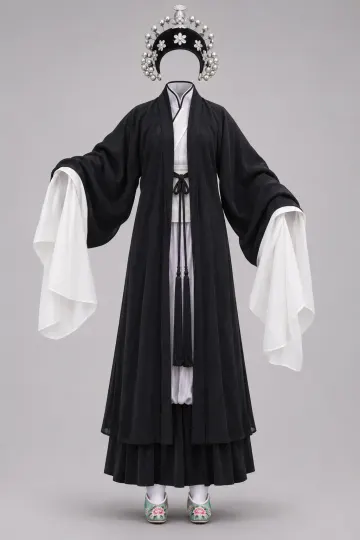
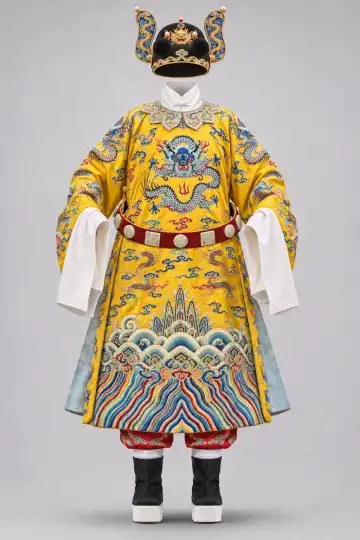
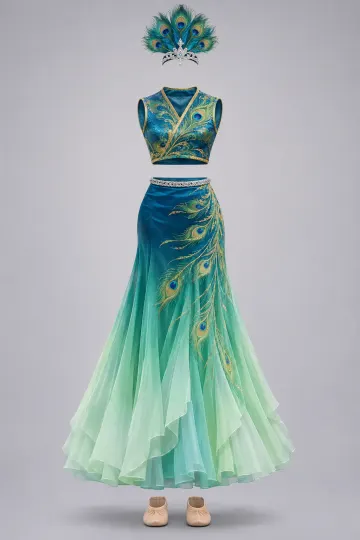
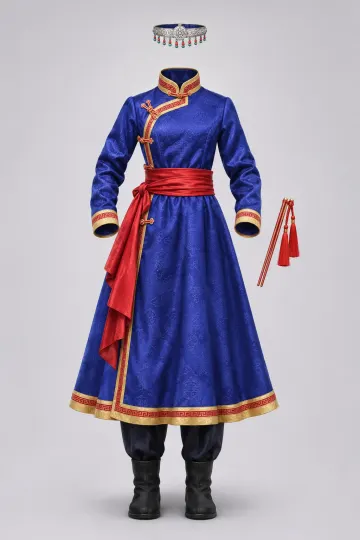
All outfit images are AI-generated. The cut, patterns and colours of historical and ethnic dress may be inaccurate. They are for creative reference only and are not a basis for serious historical or folklore research.
Black Satin Robe & Cape
黑缎长袍+斗篷
Description
黑色缎面软帽,帽前缀一颗红绒球;白色棉布交领水衣衬在内层;玄黑缎面一件式圆领大襟长袍,长及脚踝,领口、襟边与下摆用盘金线绣出云纹宽边;同色玄黑缎面斗篷,高立领,红色里衬,边缘镶金色云纹,垂至小腿;黑色缎面宽腰带束于袍外;黑色缎面彩裤,裤脚收入靴中;黑色缎面软底靴,靴筒及小腿。
Prompt
Black satin soft cap with a single red pompom at the front; white cotton cross-collar inner shirt worn beneath; one-piece jet-black satin robe with a round collar and right-side overlapping front, ankle length, its collar, front edge and hem trimmed with a broad band of couched gold-thread cloud motifs; matching jet-black satin cape with a high standing collar, red lining and gold cloud-motif edging, falling to mid-calf; wide black satin sash tied over the robe; black satin trousers tucked into the boots; black satin soft-soled boots reaching mid-calf.
About this outfit
Face-changing is a theatrical technique in which performers use special methods to rapidly alter their facial appearance onstage; the Sichuan opera tradition is especially well known.1 Face-changing methods broadly fall into two categories: altering painted facial designs and changing masks. In Sichuan opera, the chelian method uses cords to remove masks layer by layer.1 Masks used for chelian were traditionally made from coarse paper and are now commonly made from silk.1
- 人民日报《变脸艺术的魅力》(2023-04-13), 人民日报, 2023, 正文第2—3段
Compiled by AI. Sources were cross-checked independently, but AI can still make mistakes; do not use this as a direct basis for serious research.
Example images are for viewing only, not for download.
Outfit details
- Category
- Stage & theatrical
- Occasion
- Performance
- Region and culture
- China › Han
- Era
- Contemporary
- Social role
- Performer
- Gender
- Male
- Season
- All-season