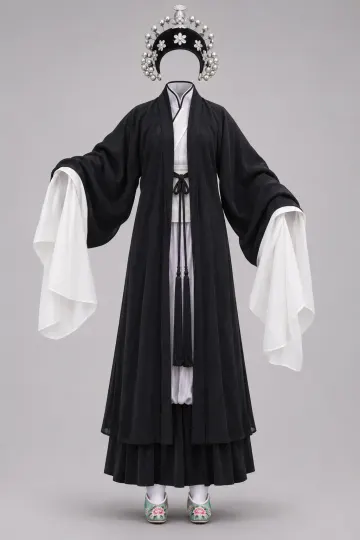
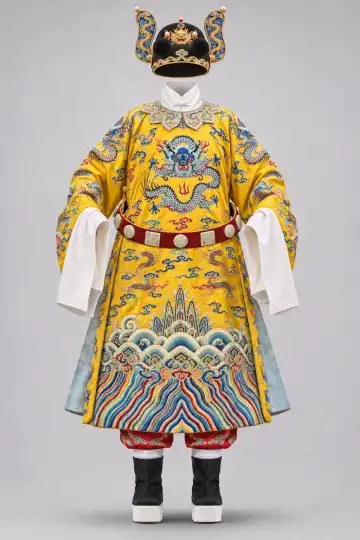
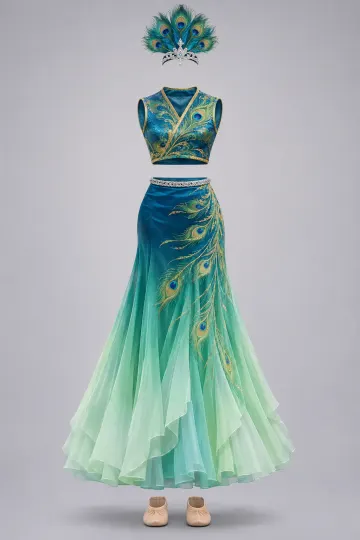
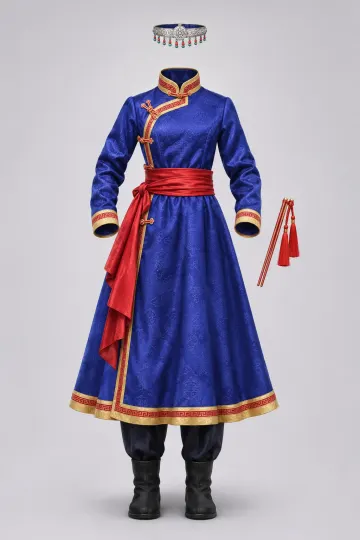
All outfit images are AI-generated. The cut, patterns and colours of historical and ethnic dress may be inaccurate. They are for creative reference only and are not a basis for serious historical or folklore research.
Lake-Blue Robe & Moon-White Trousers
湖蓝花褶子+月白彩裤
Description
头戴浅湖蓝缎面学士巾,巾体罩住头顶,顶部高出头顶约一掌,巾后垂有两根同色长飘带;颈间露出一圈缝在水衣领口的白布护领;内穿白布交领水衣,衣长及腰下;外穿浅湖蓝缎面男花褶子,宽松直身,两侧开衩,衣长及脚面,大襟右衽,右腋下系带,斜领的领缘比衣身深一号湖蓝,宽袖袖口接有垂过指尖的长白绸水袖,领边与下摆散绣几枝白色兰草;下穿月白色绸制宽腿彩裤,长及脚踝,裤脚收进靴口;足穿白布袜,外套黑缎靴面的高筒厚底靴,白色厚底明显加高。
Prompt
A pale lake-blue satin scholar's cap covers the crown of the head, rises about a hand's breadth above it, and has two long matching streamers hanging from the back; a white cloth protective collar sewn to the inner shirt shows as a band at the neckline; the inner layer is a white cloth cross-collar shirt extending below the waist; the outer layer is a pale lake-blue satin man's hua zhezi robe with a loose, straight cut, side slits and a hem reaching the tops of the feet, its overlapping front closing to the right with ties under the right arm, its diagonal collar edged in a deeper shade of lake blue, and its wide sleeves finished with long white silk water sleeves that hang past the fingertips, while a few white orchid sprigs are scattered along the collar edge and hem; moon-white silk trousers have wide legs, reach the ankles and are tucked into the boots; white cloth socks are worn inside tall boots with black satin uppers and noticeably raised white soles.
About this outfit
The zhezi is a type of informal theatrical costume used for characters in everyday settings.1 A scholar in Kunqu opera may wear a xueshi headscarf with a variable design; a xiaosheng has two streamers at the back, which may be tied together when traveling.2 White silk water sleeves are attached beyond the costume sleeves and move with the arms, extending the performer’s gestures.1 Beijing and Kunqu opera costumes favor restrained colors and simple compositions, often using floral motifs such as orchids and colors such as lake blue.1 Kunqu costume conventions take a character’s identity and circumstances into account; theatrical dress is designed for performance rather than as a reconstruction of everyday clothing from a particular dynasty.2
- 环球网艺术栏目:戏曲行头与审美文化, 正文,第1段
- 中国非物质文化遗产网论坛:戏曲学者、昆剧表演艺术家与舞美设计师谈《中国昆曲衣箱》(2010), 中国非物质文化遗产网论坛:戏曲学者、昆剧表演艺术家与舞美设计师谈, 2010, 正文,关于衣箱穿法及书生戴巾的讨论
Compiled by AI. Sources were cross-checked independently, but AI can still make mistakes; do not use this as a direct basis for serious research.
Example images are for viewing only, not for download.
Outfit details
- Category
- Stage & theatrical
- Occasion
- Performance
- Region and culture
- China › Han
- Era
- Contemporary
- Social role
- Performer
- Gender
- Male