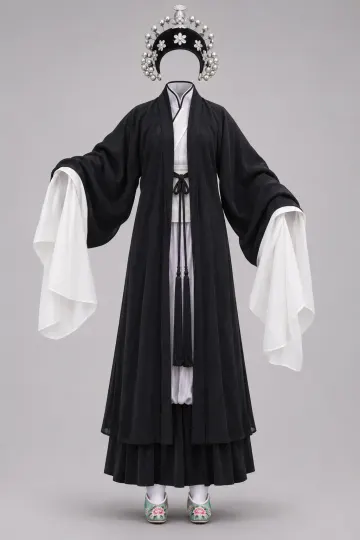
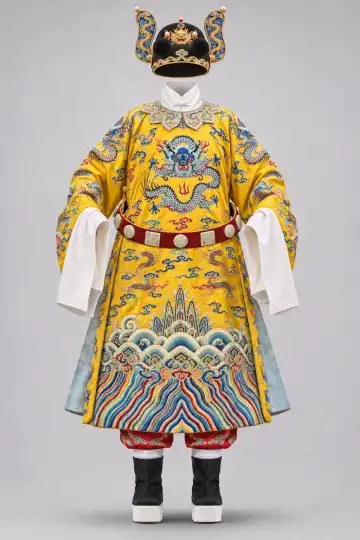
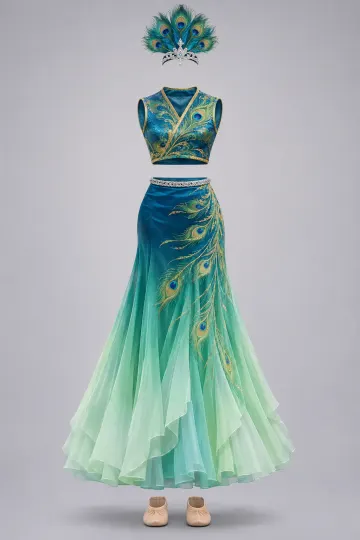
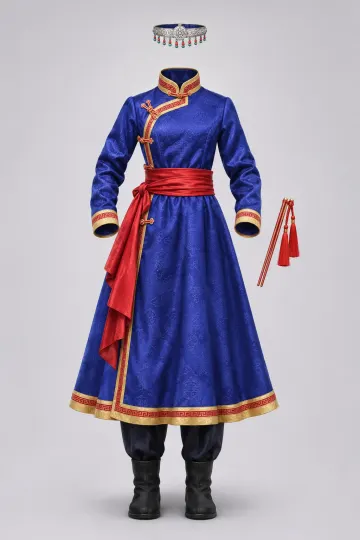
All outfit images are AI-generated. The cut, patterns and colours of historical and ethnic dress may be inaccurate. They are for creative reference only and are not a basis for serious historical or folklore research.
Happi Robe & Hangiri Hakama & Hachimaki
法被+半切袴+鉢卷
Description
白色丝质鉢卷束在额前,在脑后打结、带尾垂下;白色交领内衣;深紺与金褐格纹厚板着付;浅米金底织锦法被,满幅深蓝、墨绿、褐色大朵菊花、牡丹唐花与卷草纹,方形宽袖,前开不合,长到大腿中部;深紺底金色大几何菱纹与波纹的半切宽袴,后腰板挺,长到脚踝;深紺腰带前腰系结;白色分趾足袋;金地彩绘折扇。
Prompt
White silk hachimaki headband tied around the forehead, knotted at the back with trailing ends; white crossed-collar under-kimono; dark indigo and gold-brown checked atsuita inner robe; pale beige-gold brocade happi jacket woven all over with large chrysanthemums, peony-style flowers and scrolling vines in deep blue, dark green and brown, with wide square sleeves, worn open at the front and reaching mid-thigh; dark indigo hangiri divided skirt with very wide legs, a stiff back panel and large gold lozenge and wave patterns, reaching the ankles; dark indigo waist ties knotted at the front; white split-toe tabi socks; gold folding fan with painted decoration.
About this outfit
In the celestial maiden costume for the Noh play Hagoromo, a foil-decorated kosode is worn as the inner garment, a red-containing nuihaku kosode is wrapped around the waist, and a chōken is worn over it, with a sash and fan completing the costume.1 Karaori is primarily worn as an outer garment for female roles; its patterns are woven in silk thread, with raised threads that resemble embroidery.(partly sourced)2 The maiginu resembles the chōken and is usually worn in plays featuring the gaku dance; it is longer than the chōken, has overlapping front panels, and is sewn closed at the sides.(partly sourced)3
- 京都风俗博物馆《日本服饰史》580 能乐·羽衣シテ(天人)、581 能乐·水衣角帽子姿, 京都风俗博物馆, 580「能楽・羽衣シテ」正文
- 文化庁「文化遺産オンライン」:唐織 緑紅茶段青海波花熨斗扇夕顔模様, 文化庁, 正文
- 国立能乐堂藏「紫地霞铁线模样舞衣」说明, 国立能乐堂藏, 「紫地霞铁线模样舞衣」正文
Compiled by AI. Sources were cross-checked independently, but AI can still make mistakes; do not use this as a direct basis for serious research.
Example images are for viewing only, not for download.
Outfit details
- Category
- Stage & theatrical
- Occasion
- Performance
- Region and culture
- Japan
- Era
- Contemporary
- Social role
- Performer
- Gender
- Male
- Season
- All-season