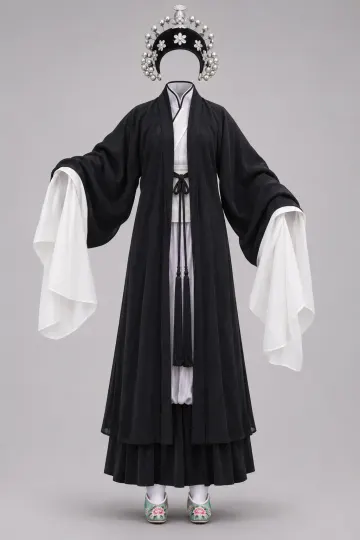
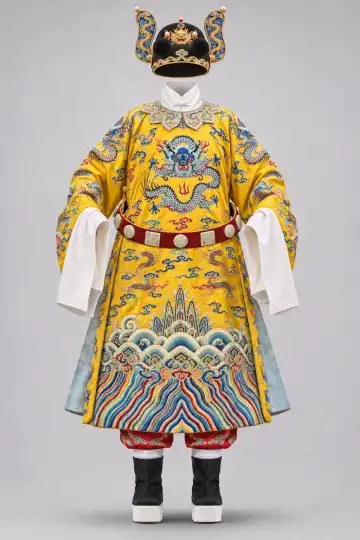
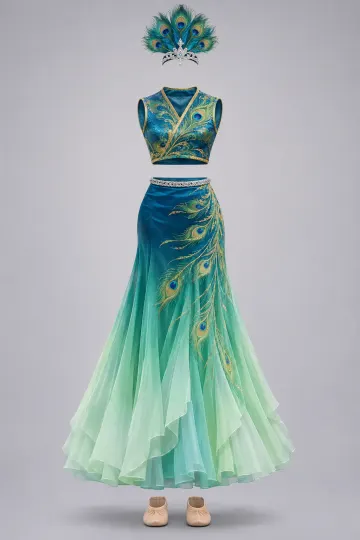
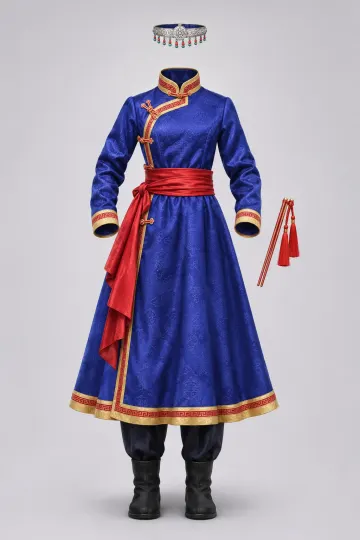
All outfit images are AI-generated. The cut, patterns and colours of historical and ethnic dress may be inaccurate. They are for creative reference only and are not a basis for serious historical or folklore research.
Vermilion Karaori & White Surihaku
朱地唐织长衣+白摺箔
Description
朱红色织锦鬘带横系额前发际,饰有夹金线的小几何织纹,脑后系结,两条带尾垂至腰际;白绢内衣为交领右衽,长及脚踝,仅在领口露出一线白边;白地薄绢摺箔着附穿在唐织内,交领右衽,领口与长及脚面的下摆略微露出,袖口窄小,饰有型印金箔的细小几何连续纹;唐织着流为交领右衽的长衣,宽而平直的领条与右衽前襟交叠,袖身方阔、袖口窄小、袖下角圆,衣摆长及脚面,厚重的织金绢以朱红为主,间有金茶色,满身浮织彩色菊花与秋草,并间以金线流水纹;金茶色夹朱红的织锦窄腰带系于腰间,固定唐织前襟;足穿白棉布分趾足袋;金地彩绘鬘扇以纸为扇面、竹为扇骨,饰有花草,扇骨上端外弯,半开时扇面向外张开。
Prompt
A narrow vermilion brocade headband crosses the hairline, patterned with small geometric weaves interlaced with gold thread, tied at the back with two ends hanging to the waist; a white silk underrobe has a right-over-left crossed collar and reaches the ankles, with only a narrow white edge visible at the neckline; a sheer white silk surihaku robe is worn beneath the outer robe, with a right-over-left crossed collar, small sleeve openings, a hem reaching the tops of the feet, and fine repeating geometric patterns printed in gold leaf, its collar and hem showing slightly; a karaori robe has a right-over-left crossed collar with broad, straight collar bands, overlapping front panels, broad square sleeves with small openings and rounded lower corners, and a hem reaching the tops of the feet; its heavy gold-woven silk is predominantly vermilion with golden-brown sections and features woven raised patterns of colorful chrysanthemums and autumn grasses interspersed with gold-thread flowing water; a narrow golden-brown brocade sash threaded with vermilion secures the robe at the waist; white cotton split-toe tabi cover the feet; a gold-ground painted katsura fan has a paper leaf, bamboo ribs that curve outward at the tips, and floral and grass motifs, with the leaf spreading outward when half open.
About this outfit
Karaori is an outer garment used mainly for female roles in Noh; the term originally referred to a type of textile.(partly sourced)1 Noh actors wear silk costumes called shozoku, whose weaving and embroidery are intricate.2 Surihaku, by contrast, is made by attaching gold leaf, silver leaf, or mica to fabric with paste or another adhesive; patterned stencils may also be used.3 The use of surihaku on clothing dates to the late Kamakura period, after which it developed alongside Noh costume.3 In the celestial maiden costume for Hagoromo, a long wig is paired with a red-patterned wig band, a foil-decorated kosode is worn underneath, and a wig fan is carried.4
- 文化庁「文化遺産オンライン」:唐織 緑紅茶段青海波花熨斗扇夕顔模様, 文化庁, 正文
- Wikipedia《Noh》Costumes 一节, Wikipedia, Costumes
- 日文维基《摺箔》, 日文维基, 正文
- 京都风俗博物馆《日本服饰史》580 能乐·羽衣シテ(天人)、581 能乐·水衣角帽子姿, 京都风俗博物馆, 580 能乐·羽衣シテ(天人)
Compiled by AI. Sources were cross-checked independently, but AI can still make mistakes; do not use this as a direct basis for serious research.
Example images are for viewing only, not for download.
Outfit details
- Category
- Stage & theatrical
- Occasion
- Performance
- Region and culture
- Japan
- Era
- Contemporary
- Social role
- Performer
- Gender
- Female
- Season
- All-season