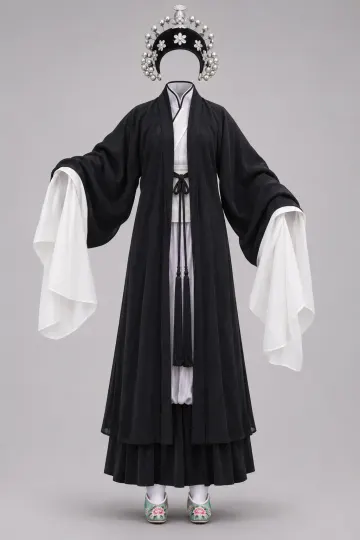
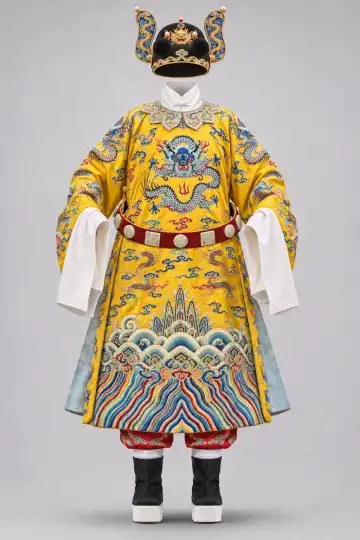
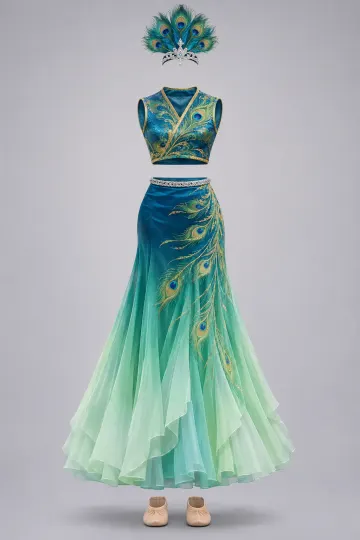
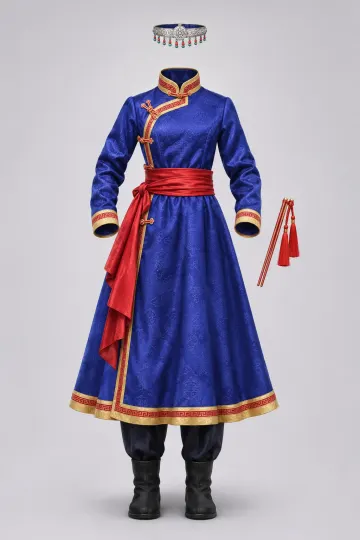
All outfit images are AI-generated. The cut, patterns and colours of historical and ethnic dress may be inaccurate. They are for creative reference only and are not a basis for serious historical or folklore research.
Noshime Kosode & Kataginu & Nagabakama
熨斗目小袖+肩衣+长袴
Description
白色绢襦袢,领口露出一道白边;墨褐色熨斗目绢小袖,垂领,袖长到手腕,衣长及踝,饰简单几何圆纹;深蓝细碎小纹麻肩衣,无袖,鲸须撑肩向两侧平直挺展,背后与两胸各一个白色几何圆纹;同色同料的深蓝长袴,前身打褶,袴脚长长拖在身后地面,后腰腰板饰一个圆纹;深灰博多织角带;白色分趾足袋;本白草编草履配白鼻绪;黑漆骨白面折扇插在腰前。
Prompt
White silk under-kimono showing a thin white edge at the collar; dark umber silk noshime kosode with a straight collar, wrist-length sleeves and an ankle-length body, decorated with simple geometric roundels; sleeveless deep-indigo hemp kataginu with a fine allover small-dot pattern, its shoulders stiffened with whalebone to stand out flat and wide, bearing white geometric roundels on the back and both sides of the chest; matching deep-indigo nagabakama trousers of the same fabric, pleated at the front, with legs so long they trail far behind on the floor and a roundel on the back waist panel; dark grey Hakata-weave kaku obi; white split-toe tabi socks; natural straw zori with white thongs; a folding fan with a white leaf and black lacquered ribs tucked into the front of the sash.
About this outfit
Kamishimo consists of a sleeveless kataginu worn over a kosode and a pair of hakama trousers. The kataginu and hakama usually match in color and fabric, although a variant called tsugi-kamishimo combines different colors and materials.(No checkable source found; for reference only) In the Edo period, samurai wore kamishimo as everyday or formal dress, while townspeople also adopted it for ceremonial occasions. Nagakamishimo, pairing a kataginu with long, trailing hakama, was formal dress for daimyo and hatamoto.(No checkable source found; for reference only) Crests could be placed on the back and both sides of the chest of the kataginu, as well as on the stiff back panel of the hakama; in the mid-Edo period, whalebone was also used to stiffen the shoulders.(No checkable source found; for reference only) Kabuki costumes often feature vivid colors and multiple layers of kimono. Hakama are worn in some plays, and padding may be placed beneath the costume to create a body shape suited to the outfit.2
- 日文维基百科:小袖、振袖、裃、羽織、袢纏、股引、襷、町火消、同心、花魁、芸者, 裃条目
- Wikipedia《Kabuki》, Wikipedia, Costumes 节
Compiled by AI. Sources were cross-checked independently, but AI can still make mistakes; do not use this as a direct basis for serious research.
Example images are for viewing only, not for download.
Outfit details
- Category
- Stage & theatrical
- Occasion
- Performance
- Region and culture
- Japan
- Era
- Contemporary
- Social role
- Performer
- Gender
- Male
- Season
- All-season