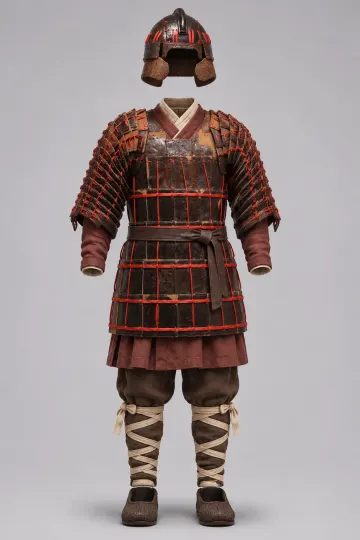
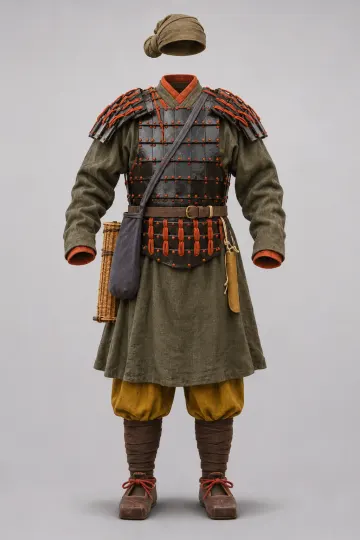
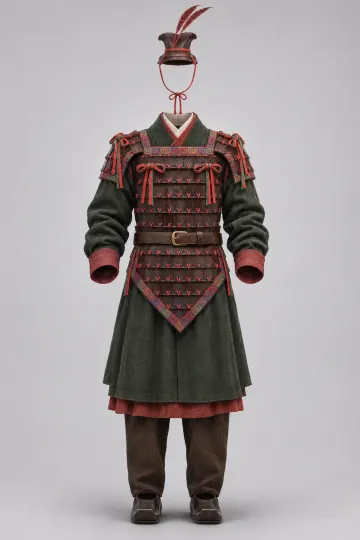
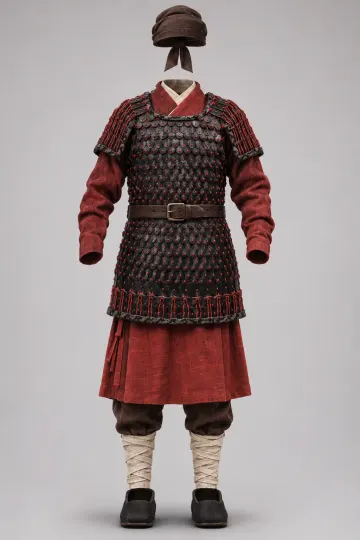
All outfit images are AI-generated. The cut, patterns and colours of historical and ethnic dress may be inaccurate. They are for creative reference only and are not a basis for serious historical or folklore research.
Orange Turban & Mail Armor & Trousers
橙红缠头+锁子甲+长裤
Description
橙红色细棉布缠绕式头巾由多道布条层层缠绕,形成整齐的斜向层次,层间深浅略有变化,顶部略扁圆;白色棉布长袖贴身内衣采用右侧斜襟,在腋下以细带系合,小圆领被甲领遮住,长袖及腕并从甲袖下露出前臂,衣长略过大腿中部;套头式锁子甲衣由钢环逐环相扣编成,夹有黄铜环与铜环,整体呈钢灰色,胸前几道黄铜环排成暗金色横纹,圆领外包深红色天鹅绒,短袖及肘,衣长至大腿中部;深红色棉布宽腰带在腰间缠绕后打结,一端垂至大腿中部,端头织有几道淡金色窄横条;白色棉布窄腿长裤臀部宽松,从膝盖以下逐渐收窄,裤口贴住脚踝;深红色软皮尖头便鞋为平底款,鞋头微微上翘,鞋面压有简单线纹,鞋边镶淡金色细边;弯刀连同深绿色素面刀鞘佩在左侧腰带上,配有铁色十字形刀柄。
Prompt
An orange-red pagri of fine cotton is wound in multiple layers, forming neat diagonal folds with subtle variations in color and a slightly flattened, rounded top; a fitted white cotton undergarment has long sleeves reaching the wrists and revealing the forearms beneath the armor sleeves, a right-overlapping front tied under the arm with narrow ties, a small round neckline covered by the armor collar, and a hem falling just below mid-thigh; a pullover mail shirt of interlinked steel rings incorporates brass and copper rings, with a predominantly steel-gray surface, several muted gold horizontal stripes across the chest formed by brass rings, a round neckline bound in deep red velvet, elbow-length short sleeves, and a mid-thigh hem; a wide deep red cotton patka is wrapped around the waist and knotted, with one end hanging to mid-thigh and finished with several narrow pale gold woven stripes; white cotton trousers are loose at the hips and taper from the knees to close-fitting ankle cuffs; deep red soft leather juti have flat soles, slightly upturned pointed toes, simple embossed line patterns, and narrow pale gold edging; a curved sword hangs from the left side of the waist belt in a plain dark green scabbard, with an iron-colored cross-shaped hilt.
About this outfit
Mirror armour developed from round metal plates and was usually worn over mail or other armour as additional protection.1 In sixteenth-century Iran, mirror plates became larger and rectangular, and this form gradually spread to Central Asia and northern India during the sixteenth and seventeenth centuries.1 Four-mirror armour typically consisted of four plates covering the front, back and sides, joined by hinges or ties, and could be worn with mail.(partly sourced)1
- Wikipedia「Char-aina」(Mirror armour), Wikipedia, Description and history
Compiled by AI. Sources were cross-checked independently, but AI can still make mistakes; do not use this as a direct basis for serious research.
Example images are for viewing only, not for download.
Outfit details
- Category
- Armor & warrior
- Occasion
- Battle
- Region and culture
- South Asia
- Social role
- Soldier
- Gender
- Male