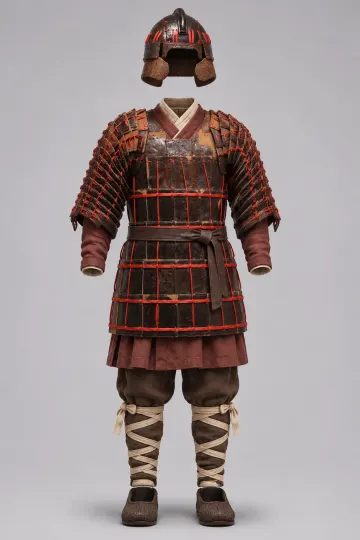
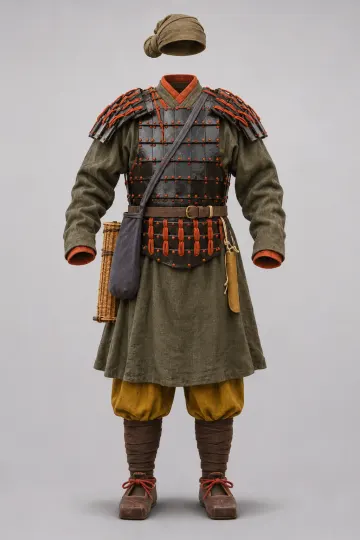
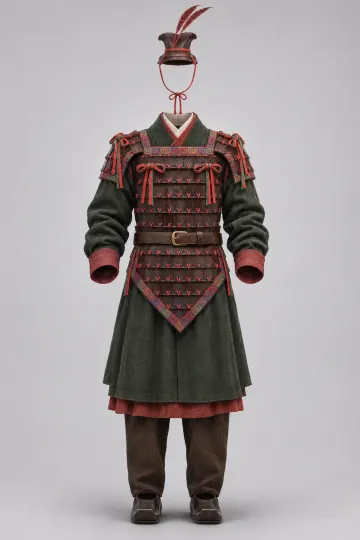
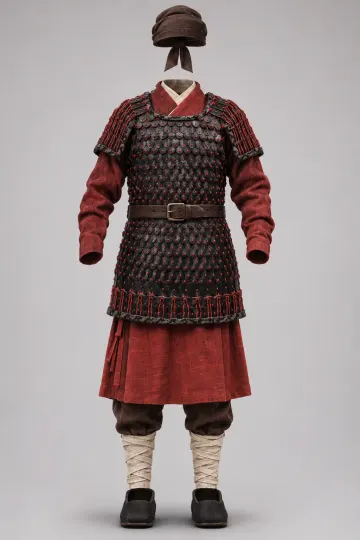
All outfit images are AI-generated. The cut, patterns and colours of historical and ethnic dress may be inaccurate. They are for creative reference only and are not a basis for serious historical or folklore research.
Four-Mirror Armor & Domed Helmet
四镜甲+圆顶钢盔
Description
暗钢灰色圆顶钢盔顶端饰有一枚短尖,盔沿镶一道窄黄铜色边,细密的锁子护颈从盔沿垂至颈后与肩部上缘;浅米白色棉布圆领长衣及膝,长袖袖口收窄,下摆露于锁子甲下;暗铁灰色套头锁子甲衫以细密铁环编成,圆领口,袖长过肘,袖口为锁子散边,衣长及大腿;四镜甲由打磨光亮的长方形钢板组成,前胸、后背及两侧各有一块,两侧板上缘内凹让出腋下,板边镶窄素面黄铜色包边,深褐色皮肩带吊住前板,甲身从胸部覆盖至腰部;浅米白色棉布长裤宽松,裤脚收口,长及脚踝;深红色宽棉布腰带在锁子甲外缠腰两圈后打结,两端短垂;深褐色软皮便鞋的鞋头微尖;亮钢银灰色钢护臂从腕部延至肘部,以皮带系住,钢护胫佩戴在小腿前侧,边缘均饰有窄黄铜色边。
Prompt
A dark steel-gray domed helmet has a short spike at the crown, a narrow brass-colored band along the brim, and a chain-mail neck guard hanging to the back of the neck and the tops of the shoulders; a light ivory cotton tunic has a round neckline, long sleeves that taper at the cuffs, and a knee-length hem visible beneath the mail shirt; a dark iron-gray pullover mail shirt is woven from closely linked iron rings, with a round neckline, sleeves extending past the elbows and ending in loose mail edges, and a thigh-length hem; a four-plate cuirass consists of polished rectangular steel plates at the chest, back, and sides, with inward-curving upper edges on the side plates to leave room under the arms, narrow plain brass-colored edging, and dark brown leather shoulder straps supporting the front plate, covering the body from chest to waist; loose light ivory cotton trousers reach the ankles and gather at the cuffs; a wide dark red cotton sash wraps twice around the waist over the mail shirt and is tied with short hanging ends; dark brown soft leather shoes have slightly pointed toes; polished steel-silver forearm guards extend from wrist to elbow and are secured with leather straps, while steel shin guards cover the fronts of the lower legs, all edged with narrow brass-colored trim.
About this outfit
Char-aina, meaning “four mirrors,” is a form of partial plate armour whose metal plates can be round or rectangular.1 It developed from round metal plates worn over other armour, usually mail, for additional protection.1 One common form has four plates, one each at the chest, back and sides, joined by hinges or straps.1 In sixteenth-century Iran, mirror plates became larger and rectangular; this form gradually spread to Central Asia and northern India during the sixteenth and seventeenth centuries.1 In the 1640s, mirror plates developed further into a mirror cuirass, sometimes fitted with plate shoulder guards.(partly sourced)1
- Wikipedia「Char-aina」(Mirror armour), Wikipedia, 正文
Compiled by AI. Sources were cross-checked independently, but AI can still make mistakes; do not use this as a direct basis for serious research.
Example images are for viewing only, not for download.
Outfit details
- Category
- Armor & warrior
- Occasion
- Battle
- Region and culture
- South Asia
- Social role
- Soldier
- Gender
- Male
- Season
- All-season