All outfit images are AI-generated. The cut, patterns and colours of historical and ethnic dress may be inaccurate. They are for creative reference only and are not a basis for serious historical or folklore research.
Lamellar Armor & Iron Helmet & Boots
札甲+铁盔+皮靴
Description
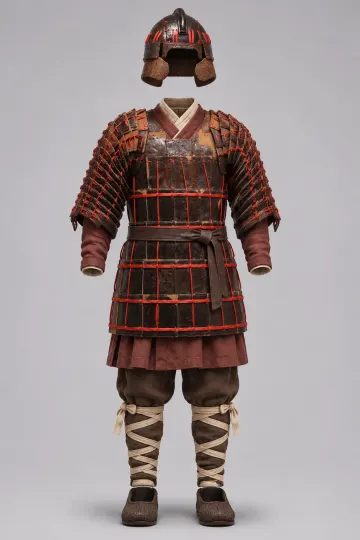
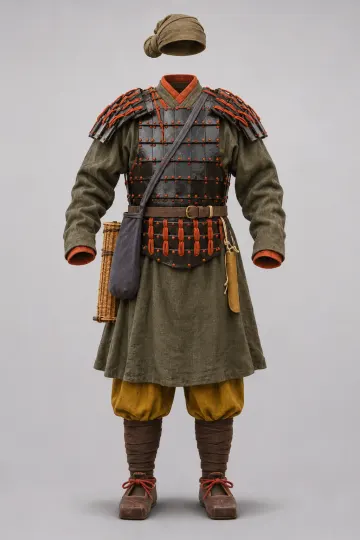
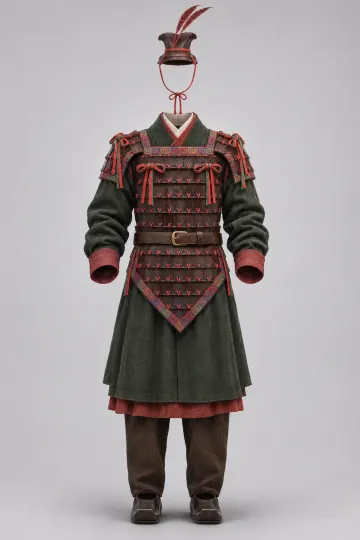
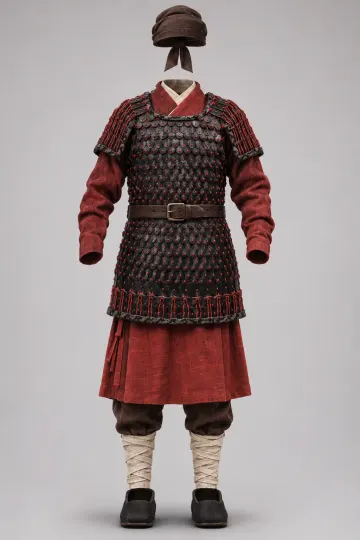
头戴由数块铁片铆合而成的铁灰色圆锥形铁盔,尖顶略高,盔沿下以浅褐色皮绳编缀一圈铁甲片护颈,垂至肩头;内穿本白色棉布或毛布贴身衬衣,交领,窄长袖;外穿深褐色厚毛呢或绗缝厚布长袍,交领右掩,以系带系合,窄长袖及腕,下摆长及小腿并从札甲下露出;长袍外穿深褐色漆皮札甲,长方形甲片打孔后以浅褐色皮绳横向编排,再逐排叠压缝连,甲身泛着暗光,前身正中开合并以皮绳系结,长至大腿中部;下穿深灰褐色厚布长裤,裤长及踝,裤腿塞入靴筒;札甲外束深褐色皮腰带;脚穿深褐色厚底高筒皮靴,靴头圆,靴筒高至膝下;背上以皮带斜挎深褐色皮革箭袋。
Prompt
A slightly tall, pointed iron-gray conical helmet is riveted together from several iron plates, with a ring of iron neck-guard plates laced beneath the brim with light brown leather cords and hanging to the shoulders; a close-fitting, natural-white cotton or wool undershirt has a crossover collar and narrow long sleeves; a deep brown robe of heavy wool or thick quilted cloth is worn over the shirt and under the armor, with a crossover collar, a right-overlapping front secured by ties, narrow wrist-length sleeves, and a calf-length hem visible below the armor; the deep brown lacquered leather lamellar armor is made of perforated rectangular plates laced horizontally with light brown leather cords and joined in overlapping rows, with a subdued sheen, a center-front opening tied with leather cords, and a hem reaching mid-thigh; dark grayish-brown heavy-cloth trousers reach the ankles and are tucked into the boots; a deep brown leather belt is fastened around the waist over the armor; deep brown leather boots have thick soles, rounded toes, and shafts reaching just below the knees; a deep brown leather quiver is slung diagonally across the back on a leather strap.
About this outfit
Mongol cavalry wore lamellar armour over thick coats. Its small elements were sewn together with leather thongs and could be made of iron, hardened leather, or mail.1 Leather armour elements were first softened by boiling, then coated with a crude pitch-based lacquer to make them waterproof.1 Another approach was to reinforce a thick coat directly with metal plates, rather than wear a separate lamellar armour over it.1 Helmets were conical, assembled from iron or steel plates of different sizes, and fitted with iron-plated neck guards. Whether a wearer had a leather or metal helmet depended on rank and wealth.1 Mongol forces used composite bows made from laminated horn, wood, and sinew. This construction allowed the bow to be compact enough for use on horseback.1
- Wikipedia《Mongol military tactics and organization》, Wikipedia, Cavalry
Compiled by AI. Sources were cross-checked independently, but AI can still make mistakes; do not use this as a direct basis for serious research.
Example images are for viewing only, not for download.
Outfit details
- Category
- Armor & warrior
- Occasion
- Battle
- Region and culture
- Mongolia
- Social role
- Soldier
- Gender
- Male