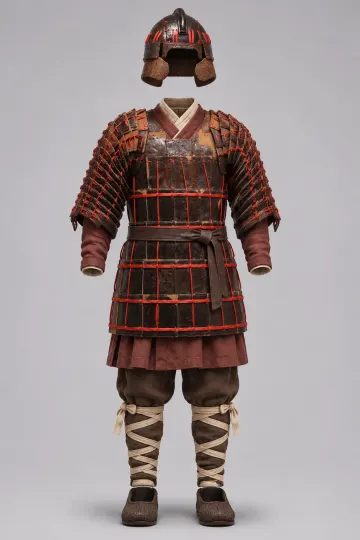
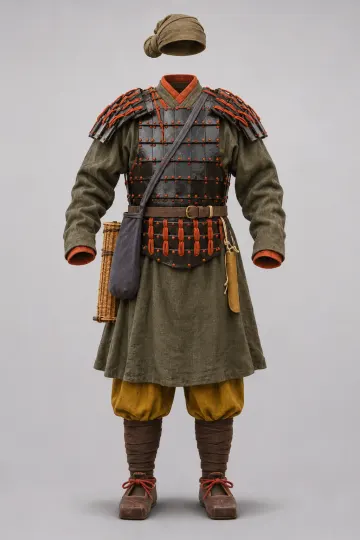
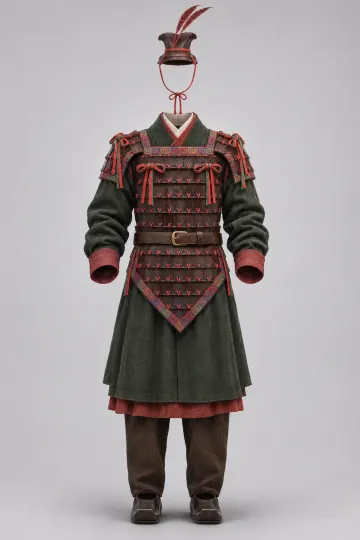
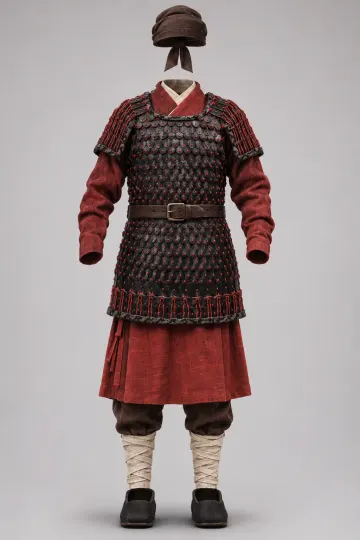
All outfit images are AI-generated. The cut, patterns and colours of historical and ethnic dress may be inaccurate. They are for creative reference only and are not a basis for serious historical or folklore research.
Crested Helmet & Steel Cuirass & Boots
铜冠钢盔+胸甲+长靴
Description
头戴钢质圆盔,短帽檐上方竖起铜冠脊,冠脊后垂黑色马鬃,两侧配铜鳞片颏带;白色亚麻衬衣在军服领口内露出一线;深蓝色毛呢骑兵军服上衣为立领长袖,袖口收窄,下摆至臀上,袖子和领口露在胸甲外;抛光钢胸甲与背甲各由整片锻钢制成,胸甲前中有竖脊,下沿接外翻护腹边,胸背甲边缘排列铜头铆钉,肩部以覆铜鳞片的皮带扣合,腰侧以皮带扣合,胸甲边缘露出窄条呢质内衬,长度至腰;米白色贴腿骑兵马裤延至膝下,裤腿收进靴筒;白色皮剑带系在胸甲下缘外侧,左侧垂挂剑吊带;黑色硬牛皮骑兵靴高过膝盖,靴筒挺括、前高后低,靴头圆润。
Prompt
A steel cavalry helmet has a rounded crown, a short visor, an upright brass crest with black horsehair trailing behind it, and brass scale chin straps at the sides; a white linen shirt shows as a narrow line inside the uniform collar; a dark navy wool cavalry tunic has a stand collar, long sleeves tapering at the cuffs, and a hem above the hips, with its sleeves and collar visible around the breastplate; the polished steel breastplate and backplate are each made from a single forged piece, with a vertical ridge down the center of the breastplate, a flared lower guard, brass-headed rivets around the edges, brass-scaled leather shoulder straps and leather side straps fastening the two plates, and a narrow strip of wool lining visible at the breastplate edge, the armor reaching the waist; close-fitting ivory cavalry breeches extend below the knees and tuck into the boots; a white leather sword belt sits outside the lower edge of the breastplate, with a sword hanger at the left side; black stiff leather cavalry boots rise above the knees, with rigid shafts cut higher in front than at the back and rounded toes.
About this outfit
Cuirassiers were cavalry equipped with a cuirass, sword, and pistols, and emerged in the second half of the 16th century.1 Early cuirassiers resembled fully armoured late medieval men-at-arms. Their three-quarter armour covered the entire upper body and the fronts of the legs down to the knees.1 Early armour included breast and back plates, with armour also protecting the shoulders and arms. By the late 17th century, cuirassiers had abandoned limb armour and wore only breast and back plates, sometimes with a helmet.1 During the first two decades of the 19th century, helmets replaced bicorne hats. Many were made of hardened leather reinforced with brass, while French cuirassiers used iron-skulled helmets.1 During the Napoleonic Wars, Austrian cuirassiers wore helmets and a half-cuirass without a back plate, unlike the paired breast and back plates worn elsewhere.1
- Wikipedia「Cuirassier」, Wikipedia, 正文
Compiled by AI. Sources were cross-checked independently, but AI can still make mistakes; do not use this as a direct basis for serious research.
Example images are for viewing only, not for download.
Outfit details
- Category
- Armor & warrior
- Occasion
- Battle
- Region and culture
- France
- Social role
- Soldier
- Gender
- Male
- Season
- All-season