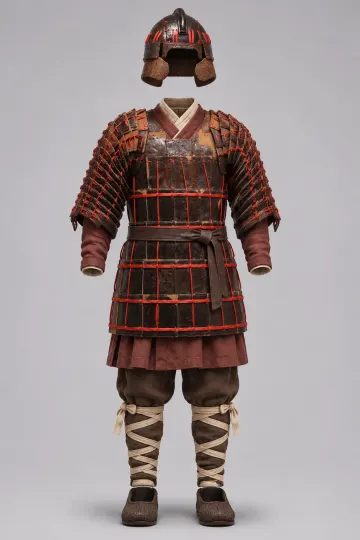
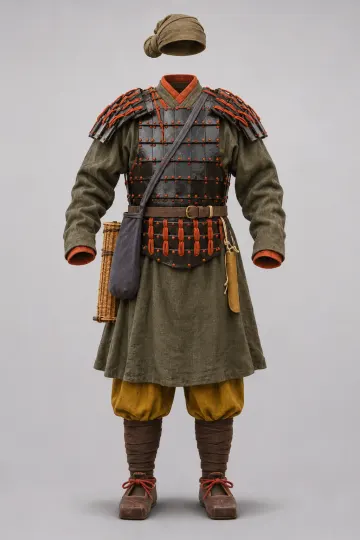
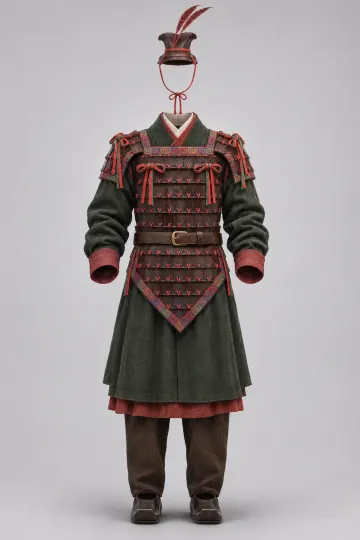
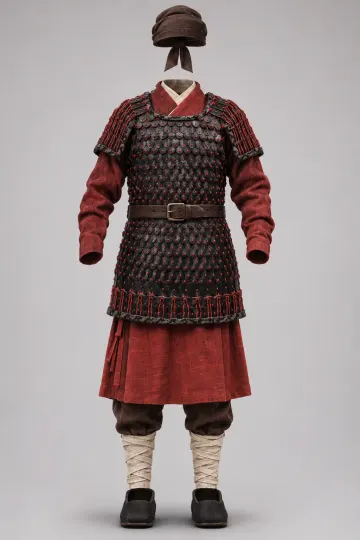
All outfit images are AI-generated. The cut, patterns and colours of historical and ethnic dress may be inaccurate. They are for creative reference only and are not a basis for serious historical or folklore research.
Visored Helmet & Plate Coat & Tabard
面甲盔+板片甲+战袍
Description
素钢灰白的尖顶巴西内盔由锻铁和钢制成,盔顶高尖,向后及两侧下延护住后颈和耳侧,较平的面甲上有一道横向观察缝,右侧有一片圆形通气孔,面甲两侧以铰链和销钉连接盔体并可上掀,盔体下缘的深褐色皮衬带钉有一排铆钉;铁灰色锁子护颈帘由相扣的铁环编成,从盔沿垂下呈短披肩形,盖住喉、颈和双肩,下缘齐平;铁灰色铁环锁子衫套头穿着,长至大腿中部,长袖至手腕,并在战袍下摆和四肢板甲的关节处露出;暗褐色布面板片外衣套在锁子衫外,覆盖胸腹,内衬成排竖向铁片,以铆钉固定,布面露出成排铁色铆钉头;深蓝色素面毛料短战袍罩在板片外衣外,采用无袖款式,前片长至大腿、后片长至膝部,前后下摆开衩;素钢灰白色锻钢臂甲包括上臂甲、圆形护肘和筒形前臂甲,以皮带扣在锁子袖外,关节处露出锁子;铁灰色锁子护腿从大腿以下延伸,外配素钢灰白色护膝和前后合抱的护胫,护膝与护胫之间露出锁子;深褐色皮腰带斜系在战袍外的胯部,配有金属带扣;铁灰色锁子护腿连至脚面,下穿深褐色尖头皮鞋。
Prompt
A pointed bascinet of wrought iron and steel in plain pale steel gray has a high peak and extends down the back and sides to protect the nape and ears; its relatively flat, hinged visor lifts on pins and has a horizontal vision slit and a patch of circular ventilation holes on the right, while a dark brown leather lining band with a row of rivets runs around the lower edge; an iron-gray aventail of interlinked iron rings hangs from the helmet rim like a short cape, covering the throat, neck, and shoulders with an even lower edge; an iron-gray mail hauberk pulls on over the head, reaches mid-thigh, and has sleeves to the wrists, with mail visible below the surcoat and at the joints of the limb armor; a dark brown cloth-covered coat of plates worn over the hauberk covers the chest and abdomen, with rows of vertical iron plates secured beneath the cloth by rivets whose iron-colored heads remain visible; a plain deep blue wool surcoat worn over the coat of plates is sleeveless, reaches the thighs in front and the knees behind, and has slits at the front and back hems; plain pale steel-gray forged steel arm armor consists of upper-arm plates, round elbow guards, and tubular forearm guards strapped over the mail sleeves, with mail visible at the joints; iron-gray mail leg coverings extend from the thighs downward beneath plain pale steel-gray knee guards and greaves that enclose the fronts and backs of the lower legs, with mail visible between the knee guards and greaves; a dark brown leather belt with a metal buckle sits diagonally at the hips over the surcoat; the iron-gray mail leg coverings extend over the tops of the feet, with dark brown pointed leather shoes underneath.
About this outfit
European armour of the fourteenth century was transitional: knights wore coats of plates over mail and gradually added more plate defences to their limbs.1 Mail was made from interlinked iron or steel rings and could conform to the contours of the body.1 The bascinet had a pointed crown and extended down at the back and sides; a mail curtain usually hung from its lower edge to protect the throat, neck and shoulders.2 From around the 1330s, bascinets were often fitted with visors; in the early fifteenth century, plate gorgets began to replace the mail curtains.2 Knights wore surcoats over their armour; in the mid to late thirteenth century, these usually reached mid-calf and had front and back slits to allow riding.3 In the early fourteenth century, the front of the surcoat became shorter than the back; this combination of mail and plates differed from the later full suit of plate armour.(partly sourced)3,1
- Wikipedia《Plate armour》, Wikipedia, 正文;Early history
- Wikipedia《Bascinet》, Wikipedia, 正文
- Wikipedia《Surcoat》, Wikipedia, History: Men's surcoat
Compiled by AI. Sources were cross-checked independently, but AI can still make mistakes; do not use this as a direct basis for serious research.
Example images are for viewing only, not for download.
Outfit details
- Category
- Armor & warrior
- Occasion
- Battle
- Region and culture
- France
- Social role
- Military officer
- Gender
- Male
- Season
- All-season