All outfit images are AI-generated. The cut, patterns and colours of historical and ethnic dress may be inaccurate. They are for creative reference only and are not a basis for serious historical or folklore research.
Iron Helmet & Studded Armor & War Robe
铁盔+钉甲+战袍
Description
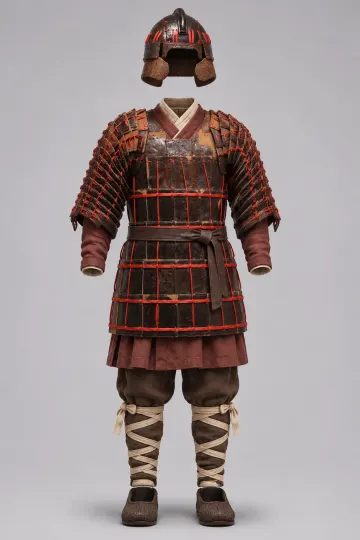
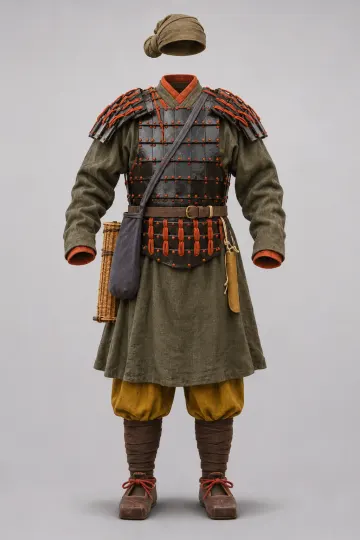
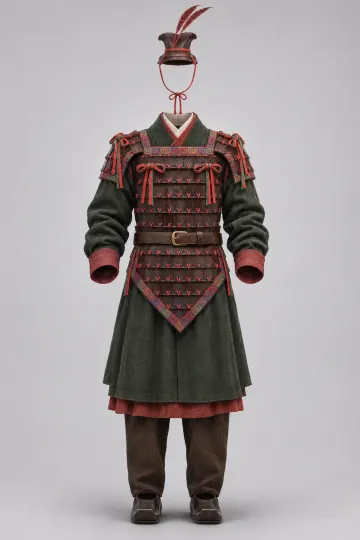
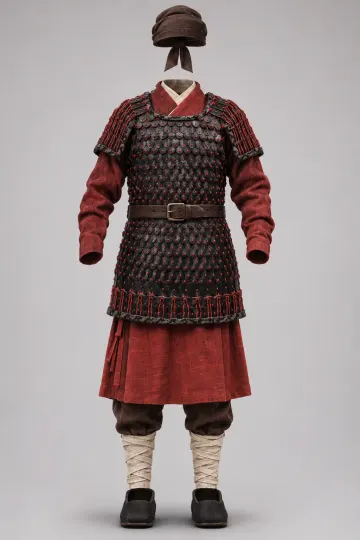
圆锥形铁盔,盔沿垂护颈与护耳;内穿衣裤;深色战袍,袍摆露于甲下;长过膝的深色厚布头钉甲,内铆铁片,外列圆头铜钉,前襟系合,两肩有短护肩;腰带;布袜;黑皮靴。
Prompt
A conical iron helmet with a neck guard and ear guards hanging from the brim; an inner garment and trousers; a dark war robe visible below the armor; dark heavy-cloth studded armor extending below the knees, with iron plates riveted inside, rows of round copper studs outside, a tied front and short shoulder guards; a belt; cloth socks; black leather boots.
About this outfit
In the later Joseon period, dujeong-gap became the principal form of armour. Its coat often extended below the knees and was paired with a conical helmet.1 Dujeong-gap had plates riveted inside an armour coat and covered by fabric, unlike earlier armour in which the plates were attached to the outside of a leather and fabric backing.1 Although hardened leather was commonly used for the plates in the later period, officers, elite soldiers and cavalry continued to wear armour with metal plates.1 A complete metal armour set from the early Joseon period included a kettle-shaped helmet, body armour reaching the thighs or knees, and shoulder guards protecting the upper arms.1 Early helmets could also have mail or lamellar neck defences, distinguishing them from the conical helmets common in the later period.(partly sourced)1
- Wikipedia「Korean armour」, Wikipedia, 朝鲜王朝甲胄相关段落
Compiled by AI. Sources were cross-checked independently, but AI can still make mistakes; do not use this as a direct basis for serious research.
Example images are for viewing only, not for download.
Outfit details
- Category
- Armor & warrior
- Occasion
- Battle
- Region and culture
- Korea
- Social role
- Military officer
- Gender
- Male
- Season
- All-season