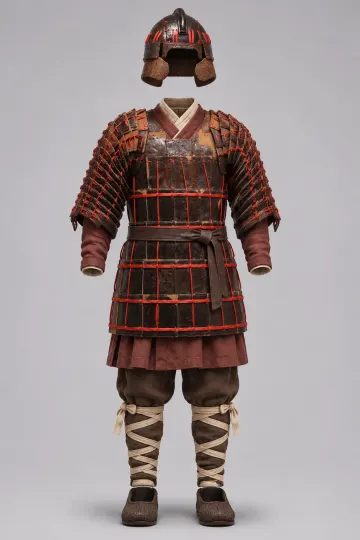
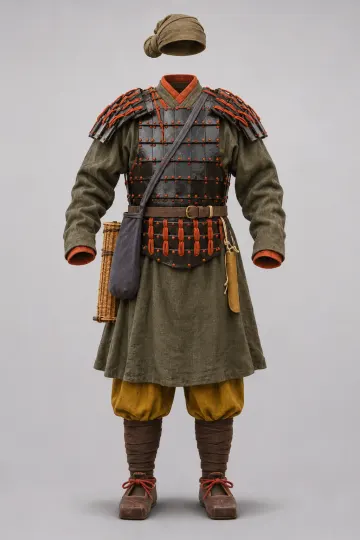
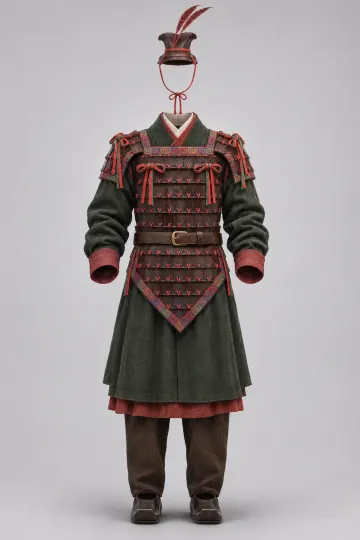
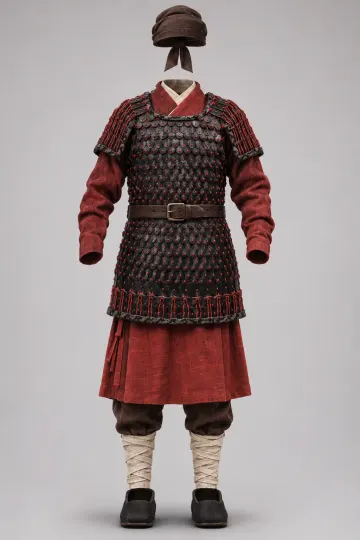
All outfit images are AI-generated. The cut, patterns and colours of historical and ethnic dress may be inaccurate. They are for creative reference only and are not a basis for serious historical or folklore research.
Suji Kabuto & Tosei Gusoku & Jinbaori
筋兜+当世具足+阵羽织
Description
黑漆筋兜,兜钵由竖向铁板拼成,表面一道道细棱,后接几层錣,前额立一枚金色月形前立;黑漆铁面颊,护住下半张脸;素白小袖;深藏青交领具足下着配阔腿袴;黑漆桶侧胴,由几道横向铁板铆接而成,胸前正中起一道竖棱;胴下垂几片黑漆草摺,用藏青丝稀疏缀连;双肩挂黑漆置袖,用藏青丝密密缀成;双臂套缀铁片和锁子的籠手;大腿前垂藏青丝密缀的佩楯;小腿装铁板加锁子的臑当,带护膝;腰间系藏青上带;外披深褐近黑的无袖皮革阵羽织,长到大腿中部,背中央有一枚金色细线几何纹;深藏青足袋;稻草编的草鞋。
Prompt
Black-lacquered suji kabuto with a bowl of vertical iron plates forming fine ridges, a layered neck guard behind, and a gilt crescent crest at the brow; black-lacquered iron half-mask covering the lower face; plain white kosode underrobe; dark navy wrap-collar under-armor jacket with wide trousers; black-lacquered okegawa-dō cuirass of horizontally riveted iron plates with a vertical center ridge; black-lacquered tasset panels hanging from the cuirass, sparsely laced in navy silk; black-lacquered shoulder guards densely laced in navy silk; armored sleeves of cloth set with iron splints and chain mail; thigh guards densely laced in navy silk; iron-splint shin guards joined with chain mail and fitted with knee caps; navy sash tied at the waist; sleeveless dark brown-black leather jinbaori reaching mid-thigh, with a single gilt-line geometric motif at the center back; dark navy tabi socks; woven straw sandals.
About this outfit
Tōsei gusoku was a form of Japanese armor that developed from the Sengoku through the Azuchi–Momoyama period, suited to large-scale warfare after the introduction of firearms.1 Compared with ōyoroi, which was largely made from laced small scales, tōsei gusoku used larger plates or solid plates, with a simpler construction and hinges to make it easier to put on and remove.(partly sourced)1 The ō-yoroi had kusazuri at the waist to protect the groin and thighs. They consisted of four sections at the front, back, left and right, with the right section hanging from the waidate.1 Such an ensemble could include a ridged helmet, shoulder guards, thigh guards, armored sleeves, and shin guards, with a sleeveless leather jinbaori worn over the armor; the shoulder and thigh guards could be densely laced with dark indigo silk.(partly sourced)2 During the Sengoku period, tōsei gusoku incorporated elements of Western armor obtained through Nanban trade and included measures against weapons such as matchlock guns and spears.1
- 日文维基百科「大鎧」「当世具足」「陣笠」「足軽」条目, 日文维基百科, 当世具足,正文
- 京都风俗博物馆《日本服饰史》:大铠武将、胴丸武士、大袖付胴丸、小具足武将、腹卷武士、腹当杂兵、当世具足与阵羽织, 京都风俗博物馆, 563 当世具足与阵羽织,正文
Compiled by AI. Sources were cross-checked independently, but AI can still make mistakes; do not use this as a direct basis for serious research.
Example images are for viewing only, not for download.
Outfit details
- Category
- Armor & warrior
- Occasion
- Battle
- Region and culture
- Japan
- Social role
- Military officer
- Gender
- Male
- Season
- All-season