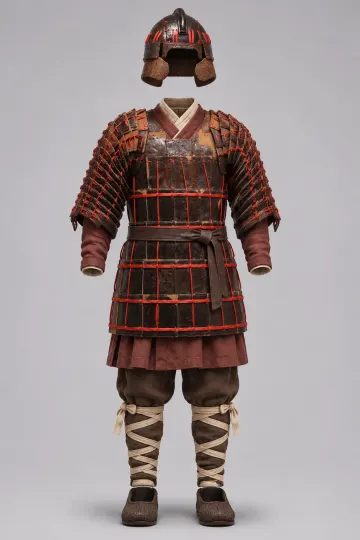
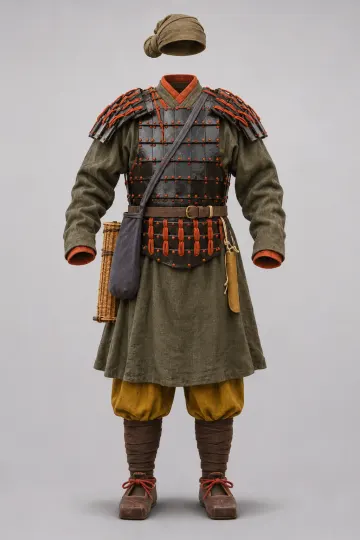
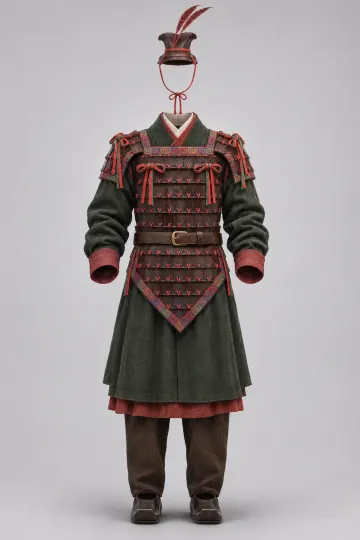
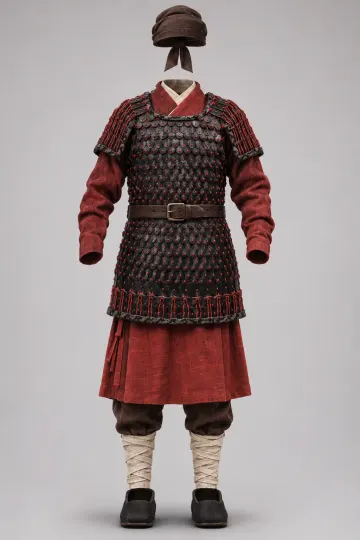
All outfit images are AI-generated. The cut, patterns and colours of historical and ethnic dress may be inaccurate. They are for creative reference only and are not a basis for serious historical or folklore research.
Hoshi Kabuto & O-Yoroi & Hitatare
星兜+大铠+直垂
Description
柔软的黑色漆绢萎乌帽子紧贴头顶,压在兜下,只在兜缘露出一线;黑漆星兜由多块竖向铁板铆合而成,钵面排列着凸起的圆头铆钉,顶部开孔,兜缘压至眉上,下接红丝编缀的小札錣,向后和两侧展开,錣两端外翻成吹返,表面贴有浅黄色小花与唐草印花鹿皮,边缘包红色覆轮,额前一对金色鍬形向上、向外分开呈U形;白色素绢小袖为交领右衽的窄袖内衣,以系带系合,长度及腰下,领口只露出一线;藏青地满布小团花锦纹的铠直垂上衣宽身交领、右衽,胸前系带,宽袖袖口穿括绳,下摆塞入袴内,左袖收进籠手,右袖从大袖下露出;大铠胴由黑漆小札以红色丝绳编缀,正面、左侧与背面连成一片,右侧由胁楯遮挡,胸前贴浅黄色花草印花鹿皮弦走韦,左侧垂鸠尾板,右侧垂三段小札组成的栴檀板,背部上段设逆板,背中央系大红色总角结,肩上连接前后,胴身及腰,最下一段饰红色交叉菱缝;一对宽大平直的长方形大袖挂在双肩,垂至近肘,由红丝编缀黑漆小札而成,上端冠板贴浅黄色花草印花鹿皮,下缘饰红色交叉菱缝;腰下前、后、左、右各有一片箱形草摺,垂至大腿中部,由红丝编缀黑漆小札而成,前后两片的最下段左右分开,右胁另有由铁制壶板和小札草摺组成的胁楯,草摺最下段饰红色交叉菱缝;宽大的铠直垂袴以与上衣同色的藏青地锦制成,裤腿在小腿处以白色布胫巾扎紧,外加由数条黑漆铁竖板连成的臑当,上部及膝下;浅黄褐色布上带横缠胴外腰间,在前侧打结,束住胴与草摺;深褐色毛皮贯靴毛朝外,包住脚与脚踝,脚背以绳系紧;左臂佩戴籠手,以藏青锦布为底,缝有黑漆铁板、铁环与锁子,从手背护至上臂,内收直垂左袖;双手各戴一只浅褐色鹿皮鞢,包住手掌与手指。
Prompt
A soft black lacquered-silk eboshi cap sits under the helmet, showing only at the rim; the black-lacquered hoshi kabuto is riveted from vertical iron plates with raised round rivets, its rim above the brows and its red-silk-laced scale neck guard spreading back and to the sides, with outturned fukigaeshi faced in pale yellow flower-printed deerskin edged in red, and a pair of gold kuwagata rising in a U at the front; a white plain-silk kosode with a tied crossover collar and narrow sleeves shows only at the neck; the loose armor hitatare jacket in dark navy brocade with small floral medallions has a crossover collar, chest ties and wide drawstring cuffs, its hem tucked into the hakama and left sleeve inside the kote;the o-yoroi cuirass of black-lacquered scales laced in red silk wraps front, left and back in one piece, with a separate waidate on the right, pale yellow printed deerskin across the chest, a kyubi-no-ita on the left, a three-section sendan-no-ita on the right, a saka-ita at the upper back, a large red agemaki knot at center back and red crossed diamond stitching on the lowest tier; broad flat rectangular o-sode of red-laced black scales hang from the shoulders to near the elbows, with printed deerskin on the top plates and red diamond stitching along the lower edges; four box-shaped kusazuri of red-laced black scales hang front, back, left and right to mid-thigh, the front and back ones split at the bottom tier; the full hitatare hakama in matching navy brocade is tied at the calves with white cloth wraps under black-lacquered iron splint shin guards reaching below the knees; a light yellow-brown cloth uwa-obi ties at the front over the cuirass; dark brown fur kutsu boots, fur outward, are cord-tied over the insteps; a kote on the left arm of navy brocade sewn with black iron plates, rings and mail guards the hand to the upper arm; light brown deerskin yugake gloves cover both hands.
About this outfit
Ōyoroi developed in the late Heian period and was worn chiefly by high-ranking mounted warriors; it was also regarded as a formal, superior type of armor.1,2 A set of ōyoroi consists of a helmet, cuirass, and shoulder guards; much of it is made from lacquered leather or iron scales overlapped horizontally and laced together in tiers.2 The front, left side, and back of the cuirass form one continuous section, while a separate right-side guard covers the opening; four skirt panels hang below the waist.2 The right chest guard is made of several tiers of scales, while the left guard is often a single iron plate; broad shoulder guards protect the shoulders and upper arms.2 A riveted helmet was commonly paired with ōyoroi, with a laced scale neck guard below the bowl and large turnbacks protecting the sides of the face; a soft eboshi cap was worn underneath.2 An armor robe was worn beneath the cuirass, and typically only the left arm bore an armored sleeve; shin wraps were covered by shin guards, and fur boots were worn on the feet.1,2
- 京都风俗博物馆《日本服饰史》:大铠武将、胴丸武士、大袖付胴丸、小具足武将、腹卷武士、腹当杂兵、当世具足与阵羽织, 京都风俗博物馆, 正文
- 日文维基百科「大鎧」「当世具足」「陣笠」「足軽」条目, 日文维基百科, 正文
Compiled by AI. Sources were cross-checked independently, but AI can still make mistakes; do not use this as a direct basis for serious research.
Example images are for viewing only, not for download.
Outfit details
- Category
- Armor & warrior
- Occasion
- Battle
- Region and culture
- Japan
- Social role
- Military officer
- Gender
- Male
- Season
- All-season