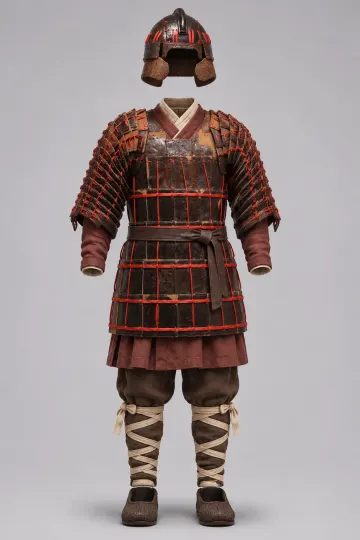
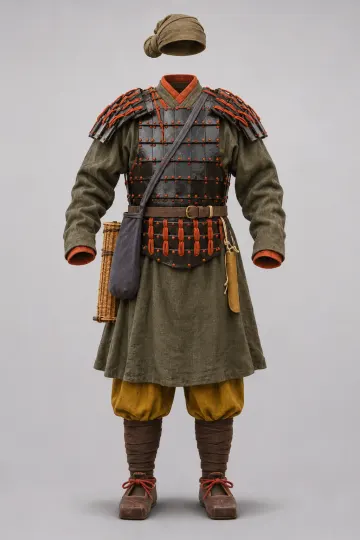
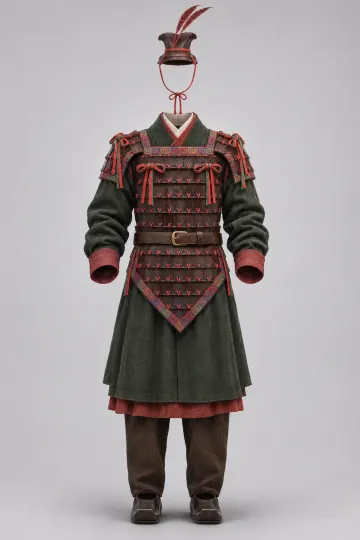
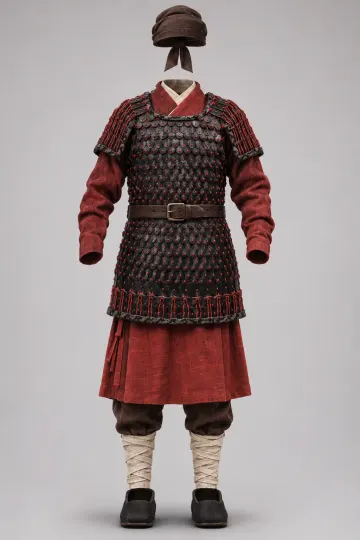
All outfit images are AI-generated. The cut, patterns and colours of historical and ethnic dress may be inaccurate. They are for creative reference only and are not a basis for serious historical or folklore research.
Bright Armor & Helmet & Cloak
明甲+头盔+披风
Description
铁黑色清式圆顶铁盔顶立细长铁管,管顶插红缨,盔沿垂有深色布面护项,以黑色缘边护住颈后与两耳;白色棉布中衣立于甲领内侧,配小立领;石青色马蹄袖箭衣为圆领、右衽大襟与窄袖,马蹄形袖口露于甲袖外,下摆前后左右开衩,衣长至小腿中部并露于腿裙下方;铁黑色札甲上身由细长铁甲片横排叠压,以深红色绳编缀,配布衬和黑布缘边,窄小立领包黑边,对襟以胸前扣袢系合,双肩披膊垂至上臂中段,胸前悬亮银色圆形护心镜,甲身长至腰部;左右两片札甲腿裙从甲带下垂至膝,铁黑色甲片横排叠压、以绳编缀,配布衬和黑色缘边;腿裙内穿深色棉布长裤,裤脚塞入靴中;黑色皮革束甲带横系于甲身与腿裙交接处;白色棉布袜搭配黑色方头高筒靴,靴筒高至小腿;深红色披风从双肩垂至小腿,在领前系结。
Prompt
A black iron Qing-style domed helmet has a slender iron tube topped with a red plume and a dark cloth neck guard edged in black that covers the back of the neck and the ears; a white cotton undergarment with a small standing collar sits inside the armor collar; a stone-blue riding robe has a round collar, a right-overlapping front, narrow sleeves with horseshoe-shaped cuffs extending beyond the armor sleeves, and slits at the front, back, and sides, with its hem reaching mid-calf below the armor skirt; the black iron lamellar cuirass is made of slender plates arranged in overlapping horizontal rows and laced with dark red cord, with a cloth lining, black cloth edging, a narrow standing collar, front fastenings, shoulder guards reaching the middle of the upper arms, and a bright silver round breast mirror, while the cuirass itself ends at the waist; two lamellar skirt panels hang from the armor belt to the knees, with overlapping rows of black iron plates laced with cord, cloth lining, and black edging; dark cotton trousers are worn beneath the skirt with their legs tucked into the boots; a black leather belt is fastened around the junction of the cuirass and skirt; white cotton socks are paired with black square-toed boots that rise to the calves; a deep red cape hangs from the shoulders to the calves and ties at the front of the collar.
About this outfit
In the 17th century, Qing forces used both lamellar and cloth-covered armour.1 Lamellar armour was also called mingjia, or exposed armour, because its plates were visible; cloth-covered armour was also called anjia, or concealed armour, because the plates were covered by fabric, with rivet heads visible on the surface.(partly sourced)1 In the Ming and Qing periods, some iron armour coats had overlapping plates arranged like roof tiles; they reached the knees and allowed flexibility at the joints.(partly sourced)1 Senior officers used mirror armour to protect vital parts of the body, while wearing lamellar or other armour over the remaining areas.1
- Wikipedia《Chinese armour》"Late imperial armour" 各节, Wikipedia, Qing dynasty
Compiled by AI. Sources were cross-checked independently, but AI can still make mistakes; do not use this as a direct basis for serious research.
Example images are for viewing only, not for download.
Outfit details
- Category
- Armor & warrior
- Occasion
- Battle
- Region and culture
- China › Manchu
- Social role
- Military officer
- Gender
- Male