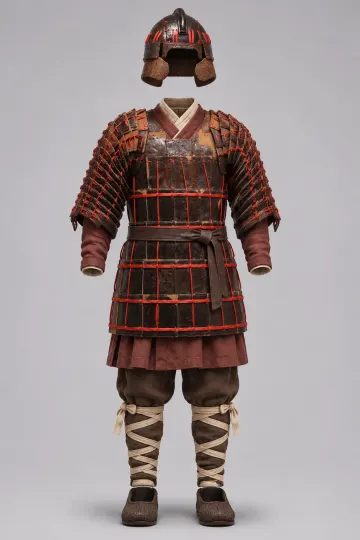
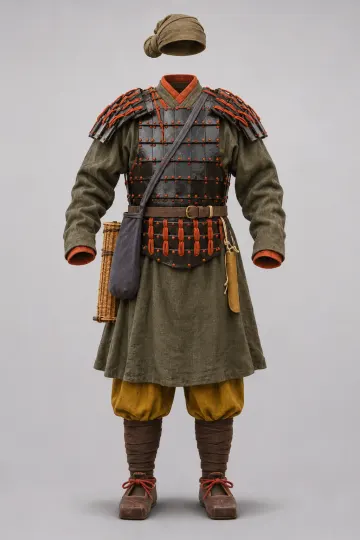
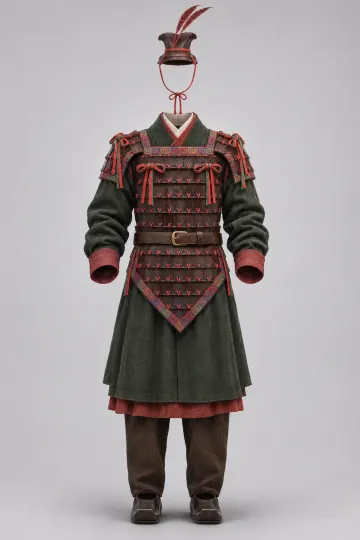
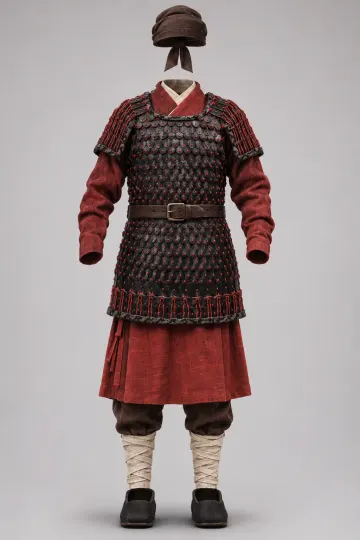
All outfit images are AI-generated. The cut, patterns and colours of historical and ethnic dress may be inaccurate. They are for creative reference only and are not a basis for serious historical or folklore research.
Padded Armor & Helmet & Tall Boots
棉甲+头盔+高筒靴
Description
头戴清式铁盔,乌黑带铁光的圆锥形盔体前有护额,铜色盔顶设舞擎座和缨管,管上插一簇红缨,顶端立有枪尖形盔枪,盔沿垂下的红布絮棉护项内衬铁片,护住两颊和后颈并垂至肩上,布面露出成排圆钉头;内穿白色棉布中衣,交领右衽,袖身窄;中衣外穿石青色棉布马蹄袖箭衣,圆领右衽,以盘扣系合,窄袖配马蹄形袖口,袍身过膝、四面开衩,穿在甲下,马蹄袖从甲袖口露出;外穿正红色布面甲上衣,立领对襟,前襟一排扣,布面絮棉并内衬铆接铁片,通身露出等距成排的银白色圆钉头,甲衣厚实硬挺,下摆至胯下,宽大护肩盖至上臂中段,窄长甲袖至手腕,腋下连有护件,胸腹下垂方形前裆至大腿上段,左右两侧挂有侧裆;下穿正红色布面甲甲裙,厚布面絮棉、内衬铁片,通身露出成排银白色圆钉头,左右两片在前中线相接,行走时可分开,裙身从腰间垂至小腿下段,露出靴筒,甲裙下穿深蓝色棉布长裤;红色棉布腰带系住甲裙腰头,束在甲衣下摆里面;白色棉布袜套在靴内;足穿满式高筒靴,黑色靴面配白色厚底,方头,靴筒高至小腿。
Prompt
A Qing-style iron helmet has a black, metallic conical crown, a forehead guard, and a copper-colored top fitted with a plume base and tube holding a cluster of red tassels beneath a spear-point finial; a red padded cloth neck guard lined with iron plates hangs from the brim to the shoulders, covering the cheeks and back of the neck, with rows of round rivet heads visible on its surface; beneath the outer garments is a white cotton underrobe with a crossed collar, a right-closing front, and narrow sleeves; over it is a slate-blue cotton archery robe with a round collar, a right-closing front fastened with cloth knot buttons, narrow sleeves, and horseshoe-shaped cuffs that emerge from the armor sleeves, while the robe falls below the knees and has slits on all four sides; the bright red cloth-covered armored jacket has a standing collar, a center-opening front with a row of buttons, cotton padding and riveted iron plates beneath its surface, and evenly spaced rows of exposed silver-white round rivet heads throughout, with a thick, structured shape, a hem below the hips, broad shoulder guards reaching the middle of the upper arms, long narrow armored sleeves reaching the wrists, underarm guards, a square front guard hanging to the upper thighs, and side guards at the hips; a bright red cloth-covered armored skirt, padded with cotton and lined with iron plates, has rows of exposed silver-white round rivet heads and two panels that meet at the center front and separate during movement, falling from the waist to the lower calves and revealing the boot shafts, with dark blue cotton trousers underneath; a red cotton sash secures the waistband of the armored skirt beneath the jacket hem; white cotton socks are worn inside the boots; Manchu-style high boots have black uppers, square toes, thick white soles, and shafts reaching the calves.
About this outfit
In the 17th century, Qing forces used both lamellar armour and cloth-covered armour.1 Cloth-covered armour had fabric or silk over plates secured with rivets, whose heads remained visible on the surface.(partly sourced)1 The quality of metal in Qing armour varied by rank: a common soldier’s armour might have only a thin, soft sheet of metal, while an officer’s could use thin, tough steel.1 In the 17th century, the Qing army used both lamellar and brigandine armour. Brigandine armour consisted of riveted plates covered with fabric.1
- Wikipedia《Chinese armour》"Late imperial armour" 各节, Wikipedia, Qing dynasty (1636–1912)
Compiled by AI. Sources were cross-checked independently, but AI can still make mistakes; do not use this as a direct basis for serious research.
Example images are for viewing only, not for download.
Outfit details
- Category
- Armor & warrior
- Occasion
- Battle
- Region and culture
- China › Manchu
- Social role
- Soldier
- Gender
- Male