All outfit images are AI-generated. The cut, patterns and colours of historical and ethnic dress may be inaccurate. They are for creative reference only and are not a basis for serious historical or folklore research.
Liangdang Cuirass & Cloak & Helmet
两当铠+披风+兜鍪
Description
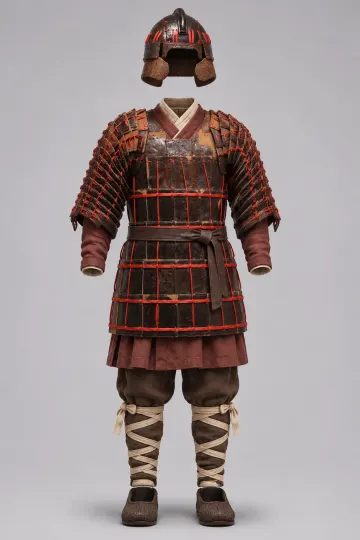
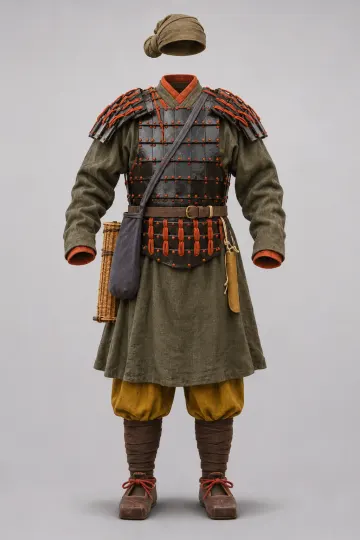
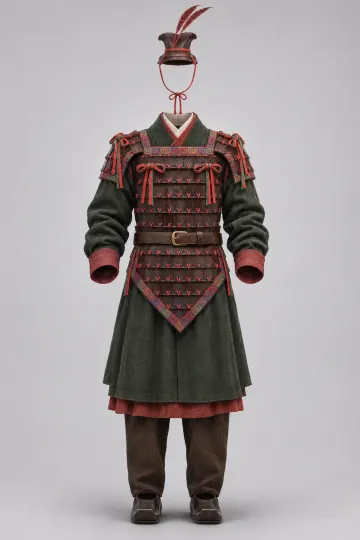
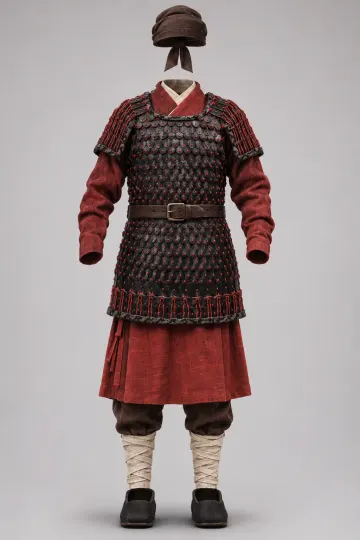
铁本色兜鍪由多片铁甲片以皮条编连而成,盔沿压至眉上,两侧及后方垂有护耳与护颈甲片,盔顶饰有一簇深红色缨饰;白色本色麻布中衣为交领右衽系带款,长及膝,仅在领口与袖口微露;深红色绛红厚麻布战袍为交领右衽系带款,窄袖长及腕部,袍身长及膝下;两当铠的胸甲与背甲各由黑漆长方形小铁札片横排叠压编缀而成,排间以红色丝绳横向穿连,四边包深青绿色缘边,内衬皮革,两片甲由可用带扣调节的皮肩带连接,腋下两侧敞开,覆盖自肩下至小腹与胯部;深赭褐色厚毛布披风为一幅长方形素布,系于两当铠的双肩肩带,垂至小腿;深褐色硬皮护臂自腕部包裹至肘下,以皮绳绑扎;红色腰绳束住两当铠的前后甲片,外系棕色皮革带,配暗金色铜扣与几枚圆形铜饰;米白色本色麻布大口裤裤管宽大,长及脚踝,膝下以细绳带扎束,带下裤管蓬松下垂;白色布袜藏于靴内;黑色皮革短靴为圆头款,靴筒至小腿下部,裤管罩在靴口上。
Prompt
A helmet of iron-colored plates joined with leather strips sits with its rim just above the eyebrows, with protective plates hanging at the sides and back to cover the ears and nape and a dark red plume at the crown; a white, natural-linen inner robe has a crossed collar, a right-closing front, ties, and a knee-length hem, with only its collar and cuffs showing; a deep crimson battle robe of thick linen has a crossed collar, a right-closing front, ties, wrist-length narrow sleeves, and a hem below the knees; the two-piece armor has separate chest and back panels made of black-lacquered rectangular iron lamellae arranged in overlapping horizontal rows, joined across the rows with red silk cords, edged in deep blue-green, and lined with leather, with adjustable buckled leather shoulder straps connecting the panels, open sides beneath the arms, and coverage from below the shoulders to the lower abdomen and hips; a plain rectangular cloak of dark ochre-brown thick wool is tied to the armor's shoulder straps and hangs to the calves; dark brown hardened leather bracers wrap from the wrists to below the elbows and are secured with leather cords; a red waist cord binds the front and back armor panels, with a brown leather belt worn over it and fitted with a muted gold-colored bronze buckle and several round bronze ornaments; wide-legged trousers of natural off-white linen reach the ankles and are tied below the knees with narrow cords, leaving the fabric below the ties loose and full; white cloth socks sit inside the boots; black leather round-toed short boots reach the lower calves, with the trouser legs falling over their tops.
About this outfit
During the Warring States period, lamellar armour became an important form of Chinese armour. Its plates could be made of leather, bronze, or iron and joined by riveting or lacing.(partly sourced)1 Lamellar armour predominated in China from the Warring States period to the Ming dynasty; cord and plaque armour became popular during the Northern and Southern dynasties.1 Cord-and-plaque armour, popular during the Northern and Southern dynasties, had a large plate over the chest and another over the back, joined by two shoulder straps and waist cords. It was sometimes mounted on a frame and could be worn over ordinary lamellar armour.1 Cord-and-plaque armour differed structurally from lamellar armour made of many small joined plates; armour names recorded in the Three Kingdoms period include liangdang, black-shining, and bright-shining armour.(partly sourced)1
- Wikipedia《Chinese armour》, Wikipedia, Ancient armour:Warring States
Compiled by AI. Sources were cross-checked independently, but AI can still make mistakes; do not use this as a direct basis for serious research.
Example images are for viewing only, not for download.
Outfit details
- Category
- Armor & warrior
- Occasion
- Battle
- Region and culture
- China › Han
- Social role
- Military officer
- Gender
- Male