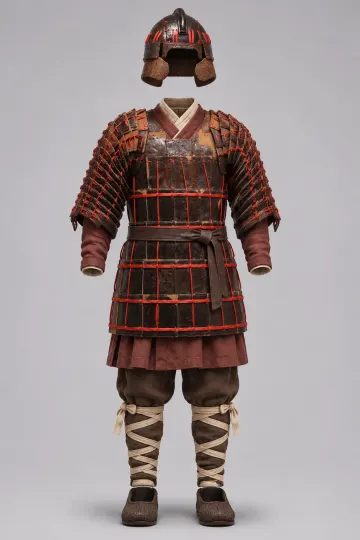
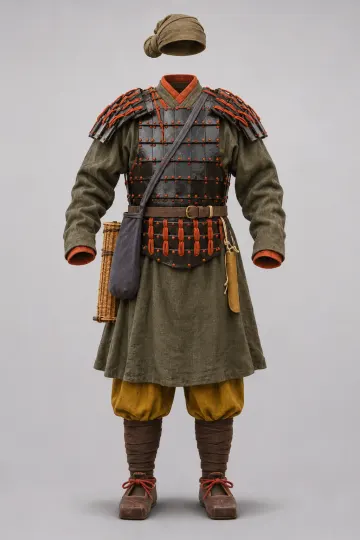
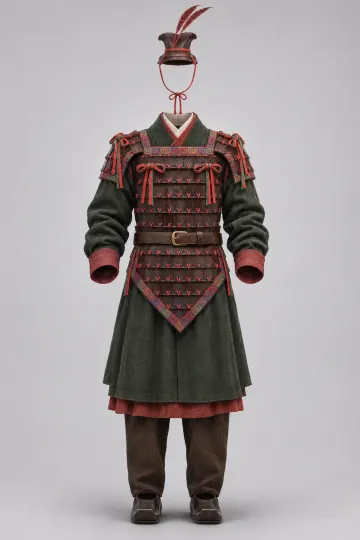
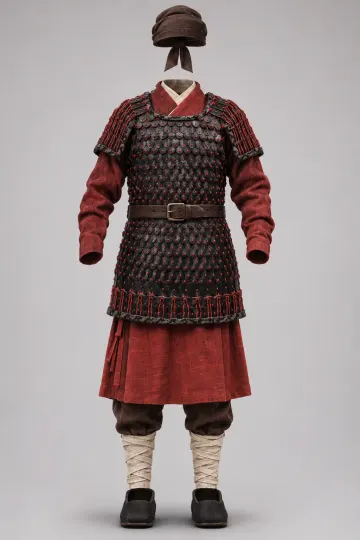
All outfit images are AI-generated. The cut, patterns and colours of historical and ethnic dress may be inaccurate. They are for creative reference only and are not a basis for serious historical or folklore research.
Lamellar Armor & Battle Robe & Cloak
札甲+战袍+披风
Description
铁黑色圆顶铁兜鍪由长条形铁片竖向铆接而成,两侧及后方垂有护耳和护颈甲片,盔顶插着一簇短朱红缨;本白色中衣为交领右衽、窄袖及膝款,领口露出一道白边;朱红色长战袍为交领右衽款,宽长袖在袖口收窄,领缘和袖缘镶深褐色边,右腋下以带系结,平直下摆及小腿中部;乌黑偏铁灰色铁札甲由圆弧形下端的长方形铁甲片层叠编成,朱红编绳成行外露,甲身包覆胸背和腹部,长至臀下,两肩接有覆盖上臂上半部的短披膊,圆领口和下摆镶有米色底褐色几何纹织锦边,胸背及侧腋系有朱红彩带;深赭红色长方形披风的两角系于胸前,披至小腿;深褐色直筒长裤及脚踝,裤脚收进袜里;深褐色革带系于札甲外的腰间,配素面青铜色带钩;本白色布袜高及小腿,包住裤脚;黑色翘头履的鞋头向上翘起。
Prompt
The iron-black domed helmet is riveted from vertical iron strips, with plates protecting the ears and nape and a short vermilion plume at the crown; the natural-white under-robe has a right-overlapping cross-collar, narrow sleeves and a knee-length hem, with a white edge visible at the neckline; the vermilion long robe has a right-overlapping cross-collar, wide long sleeves narrowing at the cuffs, dark brown edging at the collar and cuffs, ties beneath the right arm and a straight hem reaching mid-calf; the blackened iron-gray lamellar armor is made of overlapping rectangular iron plates with rounded lower ends, laced in visible rows with vermilion cord, and covers the chest, back and abdomen to below the hips, with short shoulder guards covering the upper arms, beige brocade edging woven with brown geometric patterns at the round neckline and hem, and vermilion ties at the chest, back and side; the deep reddish-ochre rectangular cloak ties at the chest and falls to the calves; the dark brown straight-leg trousers reach the ankles and are tucked into the socks; the dark brown leather belt fastens around the waist over the armor with a plain bronze-colored hook; the natural-white cloth socks reach the calves and enclose the trouser cuffs; the black shoes have upturned toes.
About this outfit
According to Giovanni da Pian del Carpine, most Mongols wore leather armour, while some had armour made entirely of iron.1 One Western Han suit of iron armour consisted of 328 plates; lamellar plates could be joined by riveting or lacing.1 Iron helmets assembled from multiple plates appeared in the Warring States period, replacing helmets made from a single piece of bronze.1 Qin generals wore a distinctive outer garment with torso armour and coloured ribbons, while the short armour of middle-ranking officers protected the torso and waist or only the chest.1
- Wikipedia《Chinese armour》, Wikipedia, Giovanni da Pian del Carpine describing Mongol lamellar armo
Compiled by AI. Sources were cross-checked independently, but AI can still make mistakes; do not use this as a direct basis for serious research.
Example images are for viewing only, not for download.
Outfit details
- Category
- Armor & warrior
- Occasion
- Battle
- Region and culture
- China › Han
- Social role
- Military officer
- Gender
- Male
- Season
- All-season